AP Physics C: Electricity and Magnetism · Unit 8 · Topic 8.5
8.5 Electric Flux: Practice Questions
Electric flux measures how much field passes through a surface. Practice computing flux for uniform fields and flat surfaces, and reasoning about flux through closed surfaces.
Free practice set · 4 multiple-choice questions · no sign-up needed
Score0 / 0
Question 1Easy
An open hemispherical bowl of radius R is in a uniform electric field of magnitude E. The flat circular rim of the bowl lies in a plane perpendicular to the field.
What is the magnitude of the electric flux through the curved surface of the bowl?
Show answer and explanation
Correct answer: A
Every field line that crosses the flat circle bounded by the rim also crosses the bowl. So the flux through the bowl equals the flux through that flat disk, EπR2, even though the bowl's area is 2πR2.
A.Correct. The flux equals that through the flat disk bounded by the rim, πR2E.
B.Multiplies E by the curved area 2πR2, ignoring that most of the surface is tilted relative to the field.
C.Uses the area of a full sphere.
D.Treats the open bowl as a closed surface; the zero net flux applies only to the bowl plus its flat cap.
Question 2Easy
A closed cylindrical surface of radius R and length L has its axis along the x-axis. It is in a uniform electric field E=Ei^ with E>0. Flux is taken as positive outward.
What is the electric flux through the end cap at the cylinder's left end (the end with smaller x)?
Show answer and explanation
Correct answer: A
Flux through a flat surface is E⋅A, with A along the outward normal. At the left cap the outward normal is opposite to the field, so the flux there is negative: field lines enter the cylinder.
A.Correct. The outward normal points along −i^, opposite to E, so Φ=−πR2E.
B.Takes the normal along +i^; for the left cap the outward direction is −i^.
C.Zero is the net flux through the whole closed surface (or the flux through the curved side), not the flux through one cap.
D.Uses the area of the curved side; the curved side is parallel to the field and has zero flux.
Question 3Moderate
A point charge q is at the center of an imaginary cube. One face of the cube is divided into four equal squares by two lines joining the midpoints of opposite edges.
What is the electric flux through one of these four small squares?
Show answer and explanation
Correct answer: B
Symmetry divides the total flux q/ε0 equally among the six faces, and a further four-fold rotational symmetry divides one face's flux equally among its four quarters.
A.This is the flux through the whole face, not one quarter of it.
B.Correct. 41⋅61⋅ε0q=24ε0q.
C.Divides the total flux by 8, as if the charge were at a corner of the cube shared by eight cubes.
D.Divides the total flux by 4 (the number of small squares) without first dividing among the six faces.
Question 4Hard
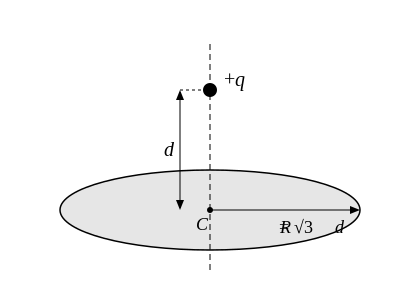
A flat circular disk of radius R = √3 d, drawn in perspective, with centre C. A dashed central axis rises from C. A point charge +q sits on the axis a distance d above C.
A point charge +q is on the central axis of a flat circular disk of radius R=3d, a distance d from the center C of the disk, as shown.
What is the magnitude of the electric flux through the disk?
Show answer and explanation
Correct answer: B
The field varies in both magnitude and direction across the disk, so the flux must be found by integrating the normal component over rings. The result is 2ε0q(1−cosθ), where θ=60° is the half-angle the disk subtends at the charge, giving q/(4ε0).
A.This is the flux through an infinite plane, which intercepts half of all the field lines; a finite disk intercepts fewer.
C.Multiplies the field at the center, kq/d2, by the disk's area 3πd2, ignoring that the field is weaker and tilted away from the center.
D.Uses the one-face-of-a-cube result, which does not apply to this geometry.
Unit 1 of every course is free
This topic has 7 more practice questions in adaptive review, plus lesson videos, unit quizzes, and progress tracking that shows which topics need work.
Unlock all eight AP courses for $10 a month or $40 through June 30, 2027. One-time payment, no auto-renewal.Pricing