AP Physics C: Electricity and Magnetism · Unit 8 · Topic 8.4
8.4 Electric Fields of Charge Distributions: Practice Questions
Rods, rings, disks and other charge distributions produce fields found by integrating the contributions of small pieces. Practice setting up those integrals and using symmetry to see which components cancel.
Free practice set · 4 multiple-choice questions · no sign-up needed
Score0 / 0
Question 1Easy
At a distance r from a very long, straight, thin wire with uniform linear charge density λ, the electric field has magnitude E0.
What is the magnitude of the electric field at a distance 2r from a second very long wire with uniform linear charge density 3λ?
Show answer and explanation
Correct answer: B
The field of a long uniform line of charge is proportional to the linear charge density and inversely proportional to the distance (not its square). Tripling the density and doubling the distance multiply the field by 3/2.
A.Uses the inverse-square dependence of a point charge instead of the 1/r dependence of a long line.
B.Correct. E∝λ/r, so the factor is 3/2.
C.Inverts the ratio, as if the field were proportional to r/λ.
D.Multiplies by the distance factor instead of dividing, as if the field grew with distance.
Question 2Easy
A thin insulating disk of radius R has total charge Q spread uniformly over its surface, with surface charge density σ. Point P is on the disk's central axis at a distance z≫R from the disk. Let k=4πε01.
Which of the following best approximates the magnitude of the electric field at P?
Show answer and explanation
Correct answer: A
Far from any finite charge distribution with nonzero net charge, the field approaches that of a point charge carrying the total charge. Expanding the exact on-axis disk field for z≫R confirms E≈kQ/z2.
A.Correct. At distances much larger than its size, the disk acts like a point charge Q.
B.This is the limit very close to the disk (z≪R), where it looks like an infinite sheet.
C.Gives a 1/z3 falloff, which describes a neutral dipole, not a distribution with net charge Q.
D.This is the field just outside a charged conductor, not the far field of a charged disk.
Question 3Hard
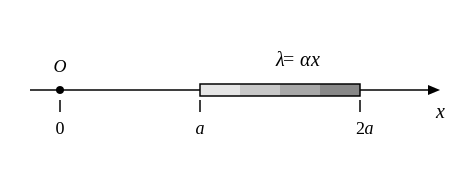
An x-axis with origin O. A thin rod lies along the axis from x = a to x = 2a, shaded darker toward its right end and labelled λ = αx. The positions 0, a and 2a are marked.
A thin insulating rod lies along the x-axis from x=a to x=2a, as shown. Its linear charge density is λ=αx, where α is a positive constant. Let k=4πε01.
What is the electric field at the origin O?
Show answer and explanation
Correct answer: A
Each small piece of the positively charged rod produces a field at the origin pointing away from the rod. Integrating kλdx/x2 with λ=αx gives kα∫dx/x=kαln2.
A.Correct. ∫a2akαxdx/x2=kαln2, pointing away from the positive rod.
B.Gets the magnitude but points the field toward the positively charged rod.
C.Treats the total charge 23αa2 as a point charge at the rod's midpoint x=1.5a; that shortcut is not exact for an extended rod.
D.Treats the density as uniform and equal to its value αa at the near end.
Question 4Moderate
A thin ring of radius R has charge Q distributed uniformly around it. Points on the ring's central axis are located by their distance z from the center of the ring.
At what distance z from the center, measured along the axis, is the magnitude of the electric field greatest?
Show answer and explanation
Correct answer: B
At the center the contributions of opposite parts of the ring cancel, and far away the field falls off as 1/z2, so the field peaks somewhere between. Setting dE/dz=0 for the on-axis field gives z=R/2.
A.At the center, contributions from opposite sides of the ring cancel, so the field there is zero, its minimum.
B.Correct. dE/dz=0 gives z2=R2/2.
C.Guesses the ring's own radius; at z=R the field is already decreasing.
D.Sets z2=2R2, an algebra slip when solving R2−2z2=0.
Unit 1 of every course is free
This topic has 7 more practice questions in adaptive review, plus lesson videos, unit quizzes, and progress tracking that shows which topics need work.
Unlock all eight AP courses for $10 a month or $40 through June 30, 2027. One-time payment, no auto-renewal.Pricing