AP Physics C: Electricity and Magnetism · Unit 8 · Topic 8.3
8.3 Electric Fields: Practice Questions
An electric field is the force per unit charge at a point. Practice finding the field of point charges, using superposition, and predicting the force and motion of a charge placed in a field.
Free practice set · 4 multiple-choice questions · no sign-up needed
Score0 / 0
Question 1Easy
In a field-line diagram of two point charges A and B drawn with a consistent number of lines per unit charge, 16 field lines start on charge A. Exactly 8 of these lines end on charge B, and the other 8 continue outward without ending on either charge. No other lines start or end on B.
Which of the following correctly describes the charges?
Show answer and explanation
Correct answer: A
Field lines point away from positive charges and toward negative charges, and the number of lines attached to a charge is proportional to its magnitude. A has twice as many lines as B.
A.Correct. Lines leave A (positive) and end on B (negative), and 16 lines versus 8 lines gives a 2:1 ratio.
B.Assumes every line from A must end on B; the extra 8 lines show that A has more charge.
C.Reverses the convention; field lines start on positive charges and end on negative charges.
D.Inverts the ratio; the charge with more lines attached has the larger magnitude.
Question 2Easy
An irregularly shaped solid metal object carries a net charge and is in electrostatic equilibrium. At a point on its surface the local surface charge density is σ.
Which of the following describes the electric field at a point just outside the surface there?
Show answer and explanation
Correct answer: B
In electrostatic equilibrium the field inside a conductor is zero and the field at its surface is perpendicular to it; otherwise surface charges would move. Gauss's law with a small pillbox gives σ/ε0, because flux leaves through only one face.
A.A parallel component would push the mobile surface charges along the surface, so the conductor would not be in equilibrium.
B.Correct. The field is normal to the surface with magnitude σ/ε0.
C.Uses the isolated-sheet result, which assumes flux leaves through both faces of the pillbox; inside the metal the field is zero.
D.The field is zero inside the metal, but not just outside a charged surface.
Question 3Moderate
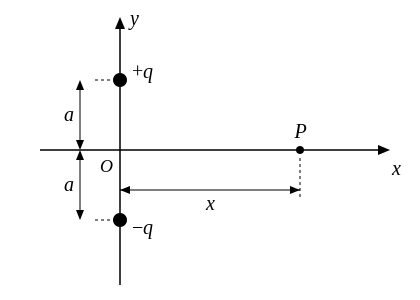
An x-y coordinate system with origin O. Point charge +q on the y-axis at y = +a; point charge −q on the y-axis at y = −a. Point P on the positive x-axis a distance x from O.
A point charge +q is fixed on the y-axis at y=+a, and a point charge −q is fixed at y=−a, as shown. Point P is on the x-axis a distance x from the origin. Let k=4πε01.
Which of the following gives the electric field at P?
Show answer and explanation
Correct answer: A
Both fields have the same magnitude at P. Their components along x cancel, while their components along y both point in the −y direction (away from +q, toward −q). Only the y-component, reduced by the factor a/r, survives.
A.Correct. The y-components add to 2(kq/r2)(a/r), directed from the positive charge side toward the negative charge side, i.e. −j^.
B.Gets the magnitude right but reverses the direction; the field of +q points away from it (downward) and the field of −q points toward it (downward).
C.Adds the two full magnitudes without taking components; only the fraction a/r of each field lies along y.
D.Assumes opposite charges cancel everywhere on the bisector; their x-components cancel but their y-components add.
Question 4Moderate
An electron enters a region of uniform electric field moving horizontally at 4.0×10⁶m/s. The field has magnitude 2.0×10³N/C and points vertically downward, and the region is 0.050m long in the direction of the electron's motion. The electron's mass is 9.11×10⁻³¹kg, e=1.60×10⁻¹⁹C, and gravity is negligible.
Which of the following best describes the electron's vertical displacement when it leaves the field region?
Show answer and explanation
Correct answer: B
The electron's negative charge makes the force opposite the field, so it accelerates upward with a=eE/m while its horizontal velocity is unchanged. Its vertical displacement follows the constant-acceleration relation y=21at2 with t=L/v0.
A.Gets the magnitude right but takes the force along the field, which is true only for a positive charge.
B.Correct. a=3.5×10¹⁴m/s2 upward for 1.25×10⁻⁸s gives 2.7cm.
C.Uses y=at2, omitting the factor 21.
D.Uses the proton mass instead of the electron mass, which makes the acceleration about 1800 times too small.
Unit 1 of every course is free
This topic has 10 more practice questions in adaptive review, plus lesson videos, unit quizzes, and progress tracking that shows which topics need work.
Unlock all eight AP courses for $10 a month or $40 through June 30, 2027. One-time payment, no auto-renewal.Pricing