AP Physics C: Electricity and Magnetism · Unit 8 · Topic 8.6
8.6 Gauss's Law: Practice Questions
Gauss's law relates the flux through a closed surface to the charge inside it. Practice choosing Gaussian surfaces for spherical, cylindrical and planar symmetry and finding the field inside and outside charged objects.
Free practice set · 4 multiple-choice questions · no sign-up needed
Score0 / 0
Question 1Easy
A long coaxial cable has a thin central wire with uniform charge +λ per unit length and a thin outer cylindrical conducting shell with uniform charge −λ per unit length. Point P is outside the cable, at a distance r from the axis that is greater than the shell's radius, far from the ends.
Which of the following correctly gives the magnitude of the electric field at P and a valid reason?
Show answer and explanation
Correct answer: A
Gauss's law with a coaxial cylinder through P relates the field at P to the net enclosed charge per unit length, which is +λ−λ=0. The symmetry guarantees that zero total flux means zero field at every point on the surface.
A.Correct. The enclosed charge is zero and symmetry makes E uniform on the curved side, so E=0.
B.The answer is right but the reason is wrong: P is outside the conductor, and a charged conductor generally does produce a field outside itself.
C.Ignores the shell's charge, which is enclosed by the Gaussian surface through P.
D.Adds the magnitudes of the two contributions instead of accounting for their opposite signs.
Question 2Easy
Two very large, thin, parallel nonconducting sheets each carry the same uniform positive surface charge density +σ.
Which of the following gives the magnitude of the electric field in the region between the sheets and in the regions outside them?
Show answer and explanation
Correct answer: A
Each sheet alone produces a uniform field σ/(2ε0) directed away from it. Superposing, the fields of like-charged sheets cancel between them and add outside.
A.Correct. The fields cancel between the sheets and add to σ/ε0 outside.
B.This is the result for oppositely charged sheets, as in a parallel-plate capacitor.
C.Adds the magnitudes everywhere, ignoring that the two fields point in opposite directions between the sheets.
D.Uses the field of a single sheet outside, ignoring the contribution of the other sheet.
Question 3Moderate
Measurements show that on an imaginary sphere of radius 0.50m, the electric field points radially inward toward the sphere's center and has magnitude 300N/C at every point. Use 4πε01=8.99×10⁹N⋅m2/C2.
What is the net charge enclosed by the sphere?
Show answer and explanation
Correct answer: B
Gauss's law turns a measured field on a closed surface into the enclosed charge: Qenc=ε0∮E⋅dA. An inward field gives negative flux and therefore a negative enclosed charge of 8.3nC.
A.Uses the area of a flat circle, πr2, instead of the sphere's surface area 4πr2.
B.Correct. Q=−Er2/k=−8.3nC.
C.Gets the magnitude right but ignores that an inward field means negative outward flux.
D.Uses r instead of r2 in Q=Er2/k.
Question 4Moderate
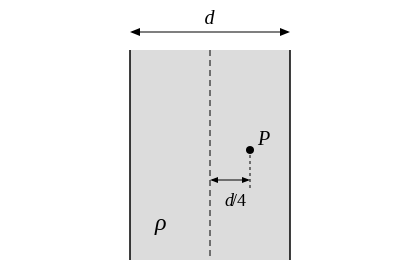
Edge-on cross section of a very large insulating slab of thickness d, shaded and labelled ρ, with a dashed line marking its central plane. Point P is inside the slab a distance d/4 to the right of the central plane.
A very large insulating slab of thickness d has a uniform positive volume charge density ρ. Point P is inside the slab, a distance d/4 from the slab's central plane, as shown.
What is the magnitude of the electric field at P?
Show answer and explanation
Correct answer: B
A Gaussian box placed symmetrically about the central plane has flux through both faces and encloses charge in proportion to its thickness, giving E=ρx/ε0 inside the slab. At a quarter of the thickness from the middle, the field is ρd/(4ε0).
A.Uses a box from the central plane to P but still counts flux through two faces; the face on the central plane has zero field and contributes no flux.
B.Correct. E=ρx/ε0 with x=d/4.
C.Gives the field outside the slab, where all the charge per area ρd is enclosed.
D.Assumes the field inside any charged object is zero; that holds for conductors in equilibrium, not for a charged insulator.
Unit 1 of every course is free
This topic has 9 more practice questions in adaptive review, plus lesson videos, unit quizzes, and progress tracking that shows which topics need work.
Unlock all eight AP courses for $10 a month or $40 through June 30, 2027. One-time payment, no auto-renewal.Pricing