AP Business with Personal Finance · Unit 1 · Topic 1.3
1.3 PESTEL Factors and the Business Environment: Practice Questions
Political, economic, social, technological, environmental, and legal (PESTEL) factors shape every market. Practice classifying a change into the right PESTEL factor and explaining how it raises or lowers a business’s viability.
Free practice set · 10 multiple-choice questions · no sign-up needed
Score0 / 0
Question 1Easy
Over the past 10 years, the share of residents age 65 and older in the town of Kirrawee rose from 14% to 23%. A home-care business that helps older adults with daily tasks is considering opening an office in Kirrawee.
The change in Kirrawee’s population is an example of which type of PESTEL factor?
Show answer and explanation
Correct answer: D
Social factors include consumer demographics, cultural norms, lifestyle trends, and population growth. A rising share of older residents is a demographic change that affects demand for home-care services.
A.Environmental factors are external conditions such as geography, resources, and waste policies, not the age of residents.
B.Economic factors include income, inflation, unemployment, and interest rates; the age makeup of a population is a demographic trend.
C.Technological factors concern the availability of technology, such as internet access and automation.
D.Correct: Social factors are trends in society and culture that affect consumers, including consumer demographics such as age.
Question 2Moderate
Ines is training to become an aquaculture technician, a worker who helps raise fish and shellfish on fish farms. She is comparing three regions where she might look for work.
Region
Access to clean coastal water
Government policy on fish farming
Fish-farm businesses operating
Bayport
Yes
Subsidies for sustainable fish farming
42
Granite Hills
No (inland, dry climate)
No policy
0
Seacliff
Yes
Ban on new fish farms to protect a nature reserve
6
Which region is likely to offer Ines the most career opportunities, and why?
Show answer and explanation
Correct answer: C
Career opportunities in a market depend on the types of businesses that are viable, based on how PESTEL factors affect the location. Bayport’s environmental factor (clean coastal water) and political factor (subsidies) support fish farming, reflected in its 42 fish-farm businesses.
A.With no access to coastal water and no fish farms operating, Granite Hills offers essentially no aquaculture jobs.
B.A ban limits business activity; it prevents new farms from opening, so it restricts rather than expands job opportunities.
C.Correct: Career opportunities depend on which businesses are viable in a location. Clean coastal water and subsidies support fish farming in Bayport, which has 42 fish-farm businesses.
D.Clean water matters, but the political ban on new farms also shapes viability; Seacliff has only 6 fish farms.
Question 3Hard
A new national law requires every food-delivery company to provide accident insurance for each of its delivery riders. The insurance costs $40 per rider each month. Speedy Basket, a grocery-delivery company, employs 250 delivery riders and currently earns a monthly operating profit of $8,000.
Which of the following best describes this change and its most likely effect on Speedy Basket?
Show answer and explanation
Correct answer: C
Legal factors are specific laws and regulations, including employment laws, and they influence viability by affecting operating costs. Insuring 250 riders at $40 each adds $10,000 per month, which exceeds the current $8,000 monthly operating profit unless Speedy Basket changes its prices or costs.
A.The law does not ban delivery; it requires insurance. Delivery remains legal for companies that provide the coverage.
B.A law about worker protection is a legal factor, and the added cost is 250 x $40 = $10,000, not $2,000 (the difference between $10,000 and $8,000).
C.Correct: Legal factors such as employment laws affect operating costs. The insurance adds 250 x $40 = $10,000 per month, more than the current $8,000 monthly operating profit.
D.The change is a specific law, not a cultural trend, and the scenario gives no evidence that demand will rise.
Question 4Moderate
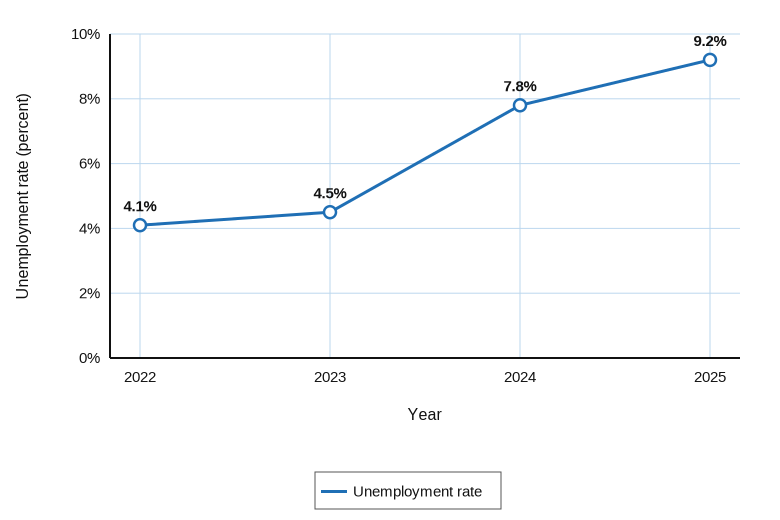
Port Harlow is a coastal town whose largest employer, a shipbuilding plant, closed in 2024. The figure shows the town's unemployment rate from 2022 to 2025.
Port Harlow unemployment rate, 2022 to 2025
Line chart titled "Port Harlow Unemployment Rate, 2022 to 2025". The unemployment rate was 4.1% in 2022, 4.5% in 2023, 7.8% in 2024, and 9.2% in 2025.
Which of the following statements about career opportunities in Port Harlow is best supported by the scenario and the figure?
Show answer and explanation
Correct answer: A
Changes in PESTEL factors may alter job availability; for example, some employees face layoffs during economic downturns. Port Harlow’s unemployment rate rose from 4.5% in 2023 to 9.2% in 2025, an increase of 4.7 percentage points after its largest employer closed.
A.Correct: Changes in PESTEL factors can alter job availability; the plant closure led to layoffs, and unemployment rose from 4.5% to 9.2%.
B.A higher unemployment rate means more people who want jobs cannot find them, which signals fewer available jobs.
C.The rate rose from 4.5% to 9.2%, an increase of 4.7 percentage points; 9.2% is the 2025 level, not the change.
D.The scenario gives no information about population age; the plant closure is the change described, and fewer people seeking work would not raise unemployment.
Question 5Moderate
Port Harlow is a coastal town whose largest employer, a shipbuilding plant, closed in 2024. The figure shows the town's unemployment rate from 2022 to 2025.
Port Harlow unemployment rate, 2022 to 2025
Line chart titled "Port Harlow Unemployment Rate, 2022 to 2025". The unemployment rate was 4.1% in 2022, 4.5% in 2023, 7.8% in 2024, and 9.2% in 2025.
Based on the data, which of the following businesses is most likely to become more viable in Port Harlow in 2026?
Show answer and explanation
Correct answer: B
Economic factors such as unemployment affect the levels and types of consumer spending. Port Harlow’s unemployment rose from 4.1% to 9.2%, and while most businesses do better in a strong economy, some, like low-cost secondhand stores, thrive by meeting needs in a weak one.
A.Rising unemployment usually lowers household income and spending on expensive, nonessential goods such as luxury furniture.
B.Correct: Some businesses thrive by meeting customer needs in a weak economy; households with less income are more likely to shop for low-cost used clothing.
C.Expensive dining is the kind of spending households tend to cut when unemployment rises.
D.Costly vacations are likely to see lower demand when more residents are out of work.
Question 6Easy
Dalia lives in a rural village where high-speed internet became available for the first time last year. She has now started a business tutoring students online in mathematics.
Which type of PESTEL factor most directly made Dalia’s business viable?
Show answer and explanation
Correct answer: A
Technological factors include internet access, and business viability depends on available technologies for delivering services and communicating with customers. High-speed internet is what allows Dalia to tutor online.
A.Correct: Technological factors include internet access. Systems for delivering services and communicating with customers depend on available technology, so new high-speed internet made online tutoring possible.
B.The scenario does not describe a government policy, such as a subsidy or mandate; it describes the arrival of internet technology.
C.Environmental factors involve geography, climate, and resources; the change that enabled the business was internet access.
D.No new law or regulation is described; the change is the availability of internet technology.
Question 7Moderate
SunReach installs rooftop solar panels on homes. It is deciding whether to expand into one of two regions, Northvale or Eastport. The table summarizes information SunReach gathered about each region.
Factor
Northvale
Eastport
Government rebate for homeowners who install solar panels
30% of system cost
None
Average sunny days per year
260
150
Unemployment rate
4%
11%
Residents surveyed who say they prefer renewable energy
64%
38%
Rules for adding rooftop panels to a home
Standard building permit, about 2 weeks
Special permit with a 6-month safety review
Which row of the table describes a legal factor?
Show answer and explanation
Correct answer: D
Legal factors are specific laws, rules, or regulations that impact market activity, including health and safety laws. The building-permit and safety-review rules for rooftop panels fit this definition.
A.A rebate is a subsidy, which the PESTEL framework classifies as a political factor.
B.Unemployment is an aspect of the economy, so it is an economic factor.
C.Consumer preferences and environmental perspectives are social and environmental factors, not laws.
D.Correct: Legal factors are specific laws, rules, or regulations, such as health and safety laws. Building permits and safety reviews for rooftop panels are such rules.
Question 8Hard
SunReach installs rooftop solar panels on homes. It is deciding whether to expand into one of two regions, Northvale or Eastport. The table summarizes information SunReach gathered about each region.
Factor
Northvale
Eastport
Government rebate for homeowners who install solar panels
30% of system cost
None
Average sunny days per year
260
150
Unemployment rate
4%
11%
Residents surveyed who say they prefer renewable energy
64%
38%
Rules for adding rooftop panels to a home
Standard building permit, about 2 weeks
Special permit with a 6-month safety review
Suppose SunReach expands into Northvale. One year later, Northvale’s government announces that the solar rebate will end. Which of the following best explains how this change is most likely to affect SunReach?
Show answer and explanation
Correct answer: C
Subsidies are political factors that support specific business activities. Changes in PESTEL factors can affect viability through their influence on customers’ ability to buy; without the 30% rebate, solar panels cost homeowners more, so fewer may buy them.
A.The rebate was paid by the government to homeowners; ending it raises homeowners’ net cost but does not increase the price SunReach receives.
B.Unchanged environmental factors do not cancel the effect of a change in a political factor; changes in any PESTEL factor can affect viability.
C.Correct: Subsidies support specific business activities. Removing one is a change in a political factor that raises the cost to customers and can reduce their ability to buy, lowering viability.
D.Ending a subsidy is a political change, not a ban; installing panels remains legal.
Question 9Easy
SunReach installs rooftop solar panels on homes. It is deciding whether to expand into one of two regions, Northvale or Eastport. The table summarizes information SunReach gathered about each region.
Factor
Northvale
Eastport
Government rebate for homeowners who install solar panels
30% of system cost
None
Average sunny days per year
260
150
Unemployment rate
4%
11%
Residents surveyed who say they prefer renewable energy
64%
38%
Rules for adding rooftop panels to a home
Standard building permit, about 2 weeks
Special permit with a 6-month safety review
The government rebate for homeowners in Northvale is an example of which type of PESTEL factor?
Show answer and explanation
Correct answer: B
Political factors are policies that affect market activity, such as trade policy, taxes and subsidies, mandates, and bans. A government rebate is a subsidy that supports solar installation.
A.Economic factors are aspects of the economy such as household income, inflation, unemployment, and interest rates; a rebate is a government policy.
B.Correct: Political factors include government policies such as taxes and subsidies. A rebate paid by the government to homeowners who install solar panels is a subsidy.
C.Legal factors are specific laws, rules, or regulations, such as health and safety laws; a rebate rewards an activity rather than regulating it.
D.Social factors are trends in society and culture, such as demographics and lifestyle trends; the rebate is a government policy.
Question 10Moderate
SunReach installs rooftop solar panels on homes. It is deciding whether to expand into one of two regions, Northvale or Eastport. The table summarizes information SunReach gathered about each region.
Factor
Northvale
Eastport
Government rebate for homeowners who install solar panels
30% of system cost
None
Average sunny days per year
260
150
Unemployment rate
4%
11%
Residents surveyed who say they prefer renewable energy
64%
38%
Rules for adding rooftop panels to a home
Standard building permit, about 2 weeks
Special permit with a 6-month safety review
Based on the information in the table, which of the following conclusions is best supported?
Show answer and explanation
Correct answer: A
Businesses use the PESTEL framework to assess how each relevant factor affects a market’s attractiveness and are more likely to enter a market where the factors align with their business model. Northvale’s subsidy, sunshine, customer preferences, and simpler permitting all favor a solar installer.
A.Correct: Evaluating each relevant PESTEL factor shows that Northvale’s political factor (the rebate), environmental factors (more sunny days and residents’ environmental perspectives), and legal factor (faster permits) all support selling and installing rooftop solar panels.
B.Labor availability is one consideration, but higher unemployment also signals weaker household income, and every other factor in the table favors Northvale.
C.The table contains no data on rival installers, and a weaker preference for renewable energy means fewer potential customers.
D.The PESTEL framework requires assessing how each relevant factor affects attractiveness and risk, not just counting whether any factor is favorable.
Unit 1 of every course is free
This topic has 2 more practice questions in adaptive review, plus lesson videos, unit quizzes, and progress tracking that shows which topics need work.
Unlock all eight AP courses for $10 a month or $40 through June 30, 2027. One-time payment, no auto-renewal.Pricing