AP Business with Personal Finance · Unit 1 · Topic 1.4
1.4 How Do Business Ideas Originate?: Practice Questions
New business ideas start with a real customer problem. Practice the design-thinking steps — observe and interview, validate the problem, build a simple MVP, test it — and explain why entrepreneurs take on the risk of a launch.
Free practice set · 10 multiple-choice questions · no sign-up needed
Score0 / 0
Question 1Moderate
Researchers at Lindqvist Appliances spent two weeks in 20 customers' homes, watching how families prepared meals without asking them any questions. They noticed that many cooks balanced a phone on the counter to follow recipe videos while their hands were covered in flour.
Which strategy for generating new product ideas did Lindqvist Appliances use?
Show answer and explanation
Correct answer: C
Businesses generate new product ideas by observing, interviewing, and surveying potential customers, investing in market and technical research, and experimenting. Watching families cook without asking questions is observation, which revealed a need for hands-free recipe viewing.
A.The researchers asked no questions; a survey collects written or verbal answers from respondents.
B.The researchers studied how people cook at home, not new materials or technologies.
C.Correct: Businesses generate product ideas by observing potential customers to identify needs; the researchers watched families cook and noticed an unmet need.
D.No product or MVP was shown to the families; the researchers were still identifying needs.
Question 2Moderate
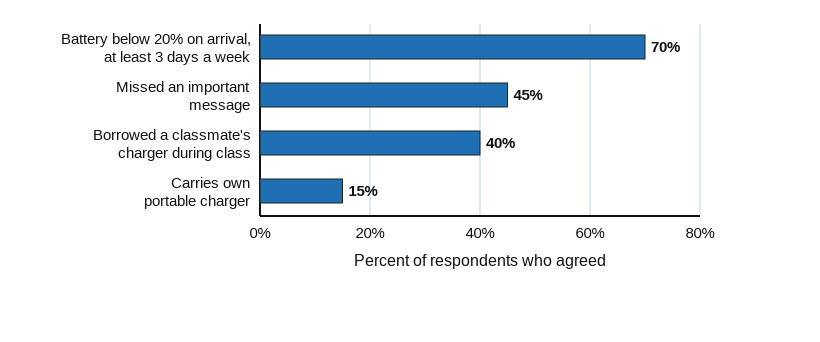
Tavita Faleolo, a university student in Auckland, noticed that many classmates who commute by bus arrive on campus with nearly dead phones. To learn more, she surveyed 120 students who commute by bus. The figure shows the percentage of respondents who agreed with each statement:
"My phone battery is below 20% when I arrive on campus at least 3 days a week."
"A low battery has made me miss an important message."
"I have borrowed a classmate's charger during class."
"I carry my own portable charger."
Survey of 120 bus commuters
Horizontal bar chart titled "Survey of 120 Bus Commuters (percent who agreed)". "My phone battery is below 20% when I arrive on campus at least 3 days a week": 70%. "A low battery has made me miss an important message": 45%. "I have borrowed a classmate's charger during class": 40%. "I carry my own portable charger": 15%.
After the survey, Tavita sketched several ideas and chose one: a coin-operated locker with a phone charger inside. She built a simple cardboard model of the locker, with only a coin slot, a lockable door, and a space for a phone and charging cable, and showed it to 30 bus commuters to get their reactions. The cardboard model is best described as
Show answer and explanation
Correct answer: A
After developing a product idea, an entrepreneur validates it by gathering feedback on a minimum viable product, the simplest version of the idea with only core features. Tavita’s cardboard locker is such a model.
A.Correct: An MVP is the simplest version of a product idea, with only core features, and may be a sketch, description, or model; it is used to gather initial feedback from potential customers.
B.The problem was already validated by the survey; reactions to the model help validate the product idea, not the problem.
C.Tavita already chose one idea from her sketches; the model represents that chosen idea.
D.A cardboard model with only core features is a simple early version used to gather feedback, not a product ready to sell.
Question 3Moderate
Tavita Faleolo, a university student in Auckland, noticed that many classmates who commute by bus arrive on campus with nearly dead phones. To learn more, she surveyed 120 students who commute by bus. The figure shows the percentage of respondents who agreed with each statement:
"My phone battery is below 20% when I arrive on campus at least 3 days a week."
"A low battery has made me miss an important message."
"I have borrowed a classmate's charger during class."
"I carry my own portable charger."
Survey of 120 bus commuters
Horizontal bar chart titled "Survey of 120 Bus Commuters (percent who agreed)". "My phone battery is below 20% when I arrive on campus at least 3 days a week": 70%. "A low battery has made me miss an important message": 45%. "I have borrowed a classmate's charger during class": 40%. "I carry my own portable charger": 15%.
Which of the following findings provides the strongest evidence that the problem Tavita noticed is experienced by multiple potential customers?
Show answer and explanation
Correct answer: C
At the problem-validation stage, an entrepreneur gathers evidence that the problem exists, can be clearly defined, and is experienced by multiple potential customers. Seventy percent of 120 respondents, or 84 students, reported the specific low-battery problem.
A.One person’s experience does not show that the problem is experienced by multiple potential customers.
B.This finding (15% of 120 = 18) shows how many students already solve the problem for themselves; it is not evidence of how many experience it.
C.Correct: Validation means gathering evidence that the problem exists, is clearly defined, and is experienced by multiple potential customers; 70% of 120 = 84 students reported this specific problem.
D.One friend’s opinion is not evidence that many potential customers share the problem, and it concerns a product rather than the problem.
Question 4Easy
Tavita Faleolo, a university student in Auckland, noticed that many classmates who commute by bus arrive on campus with nearly dead phones. To learn more, she surveyed 120 students who commute by bus. The figure shows the percentage of respondents who agreed with each statement:
"My phone battery is below 20% when I arrive on campus at least 3 days a week."
"A low battery has made me miss an important message."
"I have borrowed a classmate's charger during class."
"I carry my own portable charger."
Survey of 120 bus commuters
Horizontal bar chart titled "Survey of 120 Bus Commuters (percent who agreed)". "My phone battery is below 20% when I arrive on campus at least 3 days a week": 70%. "A low battery has made me miss an important message": 45%. "I have borrowed a classmate's charger during class": 40%. "I carry my own portable charger": 15%.
Tavita’s survey is part of which stage of the entrepreneurial design-thinking process?
Show answer and explanation
Correct answer: B
The entrepreneurial design-thinking process begins with observing, interviewing, and/or surveying potential customers to identify and validate a problem. Tavita’s survey gathers evidence about the low-battery problem before any product idea exists.
A.Brainstorming and sketching come after the problem has been identified and validated; the survey asks about the problem, not about product ideas.
B.Correct: The design-thinking process begins by observing, interviewing, and/or surveying potential customers to identify and validate a problem, need, or want.
C.Tavita has not yet developed a product idea or a minimum viable product to show anyone.
D.Value capture concerns pricing a product above its cost; Tavita does not yet have a product to sell.
Question 5Hard
Tavita Faleolo, a university student in Auckland, noticed that many classmates who commute by bus arrive on campus with nearly dead phones. To learn more, she surveyed 120 students who commute by bus. The figure shows the percentage of respondents who agreed with each statement:
"My phone battery is below 20% when I arrive on campus at least 3 days a week."
"A low battery has made me miss an important message."
"I have borrowed a classmate's charger during class."
"I carry my own portable charger."
Tavita took the following four actions, listed here in random order.
I. Showed a cardboard model of a charging locker to 30 commuters and recorded their reactions
II. Surveyed 120 bus commuters about their phone batteries
III. Sketched several possible products, including a charging locker, a bus-seat charger, and a battery-rental kiosk
IV. Watched classmates search for open electrical outlets in the library
Survey of 120 bus commuters
Horizontal bar chart titled "Survey of 120 Bus Commuters (percent who agreed)". "My phone battery is below 20% when I arrive on campus at least 3 days a week": 70%. "A low battery has made me miss an important message": 45%. "I have borrowed a classmate's charger during class": 40%. "I carry my own portable charger": 15%.
Which of the following sequences follows the entrepreneurial design-thinking process?
Show answer and explanation
Correct answer: C
Design thinking starts by observing, interviewing, and/or surveying potential customers to identify and validate a problem (IV, II), then develops a potential solution by brainstorming, sketching, and prototyping (III), and then validates the idea with feedback on a minimum viable product (I).
A.Sketching product ideas comes after the problem has been identified and validated, so it cannot come first.
B.The survey that validates the problem must come before developing and testing a product idea, not after the MVP feedback.
C.Correct: The process begins by observing (IV) and surveying (II) to identify and validate the problem, then develops a solution through sketching (III), then gathers feedback on an MVP (I).
D.Feedback on an MVP cannot come before a product idea has been sketched and developed.
Question 6Easy
Ji-woo Park left her salaried job as a veterinary assistant in Busan and used $30,000 of her savings to buy a van and start a mobile dog-grooming service.
Which of the following best explains why Ji-woo is an entrepreneur?
Show answer and explanation
Correct answer: D
An entrepreneur is an individual who develops a new business and assumes the risks and potential rewards. Ji-woo started a new business with her own savings, so she bears its risks and rewards.
A.Specialized training does not make someone an entrepreneur; Ji-woo also worked with animals as a salaried employee.
B.Entrepreneurs face risk, so a new business guarantees no particular income.
C.Buying equipment does not by itself make a person an entrepreneur; employees of existing businesses also use such resources.
D.Correct: An entrepreneur is an individual who develops a new business and assumes the risks and potential rewards; Ji-woo invested her own savings in a new grooming service.
Question 7Easy
Kestrel Outdoor, a company in Calgary that has made hiking backpacks for 15 years, is considering launching its first line of tents. The tables show the estimated launch costs and three forecasts of first-year revenue from the tents.
Launch cost
Amount
Sewing equipment
$40,000
Tent fabric and poles
$25,000
Hiring and training staff
$35,000
Total
$100,000
First-year revenue forecast
Amount
---
---
Low
$60,000
Expected
$130,000
High
$210,000
Which of the following most likely explains why Kestrel Outdoor is willing to take the risk of launching the tents?
Show answer and explanation
Correct answer: A
The potential to earn future profits is one incentive for bearing the risk of bringing a new product to market. Kestrel’s expected revenue ($130,000) exceeds the launch cost ($100,000), although this outcome is not guaranteed.
A.Correct: Businesses are incentivized to bear the risk of a new product by the potential to earn future profits; expected revenue of $130,000 is greater than the $100,000 launch cost.
B.There is no guarantee that a new product will generate enough revenue; the low forecast of $60,000 would not cover the costs.
C.The launch costs $100,000; existing backpack sales do not remove the need for financial resources.
D.The low forecast of $60,000 is less than the $100,000 launch cost, so the tents could lose money.
Question 8Moderate
Kestrel Outdoor, a company in Calgary that has made hiking backpacks for 15 years, is considering launching its first line of tents. The tables show the estimated launch costs and three forecasts of first-year revenue from the tents.
Launch cost
Amount
Sewing equipment
$40,000
Tent fabric and poles
$25,000
Hiring and training staff
$35,000
Total
$100,000
First-year revenue forecast
Amount
---
---
Low
$60,000
Expected
$130,000
High
$210,000
Which of the following best describes the risk Kestrel Outdoor faces in launching the tents?
Show answer and explanation
Correct answer: B
Bringing a new product to market is risky because it requires financial, physical, and human resources, which have costs, and there is no guarantee the product will generate enough revenue to cover them. If revenue is only $60,000, Kestrel would fall $40,000 short of its $100,000 launch cost.
A.A forecast is not a guarantee; actual revenue could be as low as the $60,000 low forecast.
B.Correct: Bringing a new product to market requires financial, physical, and human resources that have costs, and there is no guarantee revenue will cover them; the low forecast is $40,000 short.
C.All the resources used in the launch have costs, including equipment and materials, and nothing guarantees they can be recovered.
D.Experience with backpacks does not guarantee that a new product, tents, will generate enough revenue to cover its costs.
Question 9Moderate
Kestrel Outdoor, a company in Calgary that has made hiking backpacks for 15 years, is considering launching its first line of tents. The tables show the estimated launch costs and three forecasts of first-year revenue from the tents.
Launch cost
Amount
Sewing equipment
$40,000
Tent fabric and poles
$25,000
Hiring and training staff
$35,000
Total
$100,000
First-year revenue forecast
Amount
---
---
Low
$60,000
Expected
$130,000
High
$210,000
Sewing equipment and tent fabric and poles are physical resources. What percentage of the total launch cost is for physical resources?
Show answer and explanation
Correct answer: D
Physical resources are the sewing equipment ($40,000) and the tent fabric and poles ($25,000), a total of $65,000. Divided by the $100,000 total launch cost, that is 65%.
A.This is the share for tent fabric and poles only ($25,000 of $100,000); it leaves out the sewing equipment.
B.This is the share for hiring and training staff, which is a human resource, not a physical resource.
C.This is the share for sewing equipment only; it leaves out the tent fabric and poles.
D.Correct: Physical resources cost $40,000 + $25,000 = $65,000, and $65,000 / $100,000 = 65% of the total launch cost.
Question 10Hard
Rosa Mendoza wants to start a business that helps working parents in Lima. Before developing any product, she wants evidence that validates a problem.
Which of the following findings would best meet the criteria for validating a problem in the entrepreneurial design-thinking process?
Show answer and explanation
Correct answer: B
At the start of design thinking, validation means gathering evidence that a problem exists, can be clearly defined, and is experienced by multiple potential customers. Only the interview finding, 40 of 60 parents describing the same specific problem, meets all three criteria.
A.The problem is clearly defined, but one parent does not show that it is experienced by multiple potential customers.
B.Correct: Validation means evidence that the problem exists, can be clearly defined, and is experienced by multiple potential customers; this finding meets all three.
C.Many parents responded, but "generally unhappy" is not a clearly defined problem a product could address.
D.Feedback on a sketch validates a product idea (an MVP), which comes after the problem is validated; Rosa has not yet developed any product.
Unit 1 of every course is free
This topic has 1 more practice questions in adaptive review, plus lesson videos, unit quizzes, and progress tracking that shows which topics need work.
Unlock all eight AP courses for $10 a month or $40 through June 30, 2027. One-time payment, no auto-renewal.Pricing