AP Business with Personal Finance · Unit 1 · Topic 1.2
1.2 Markets and Competitive Advantage: Practice Questions
Buyers and sellers meet in markets, and competition decides who wins customers. Practice reading market prices, judging how competitive a market is, and choosing a plan for competitive advantage: lower costs, a better product, or barriers to entry.
Free practice set · 10 multiple-choice questions · no sign-up needed
Score0 / 0
Question 1Moderate
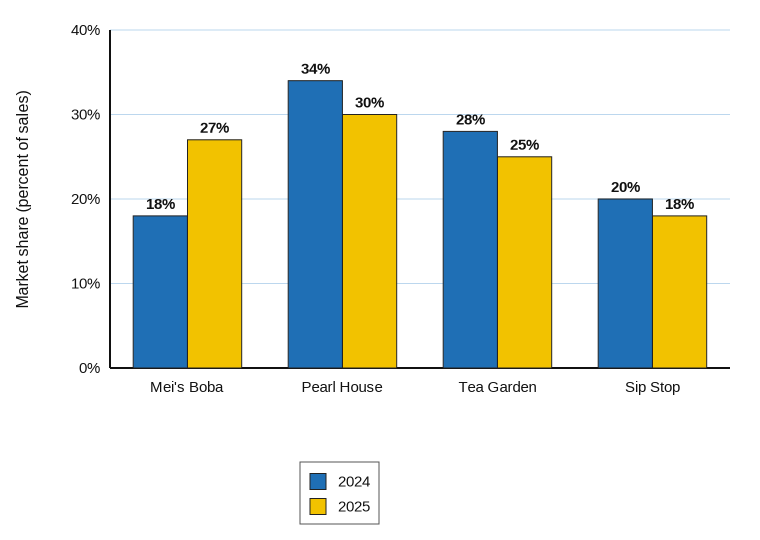
Four shops sell bubble tea in the downtown district of a city. Each shop offers drinks with somewhat different flavors, toppings, and service. In 2025, Mei's Boba added fresh-fruit toppings that no rival offered and launched a loyalty app that lets customers order ahead and skip the line. The figure shows each shop's market share (percentage of all downtown bubble tea sales) in 2024 and 2025.
Downtown bubble tea market share, 2024 and 2025
Grouped bar chart titled "Downtown Bubble Tea Market Share, 2024 and 2025" (percent of all downtown bubble tea sales). Mei's Boba: 18% in 2024, 27% in 2025. Pearl House: 34% in 2024, 30% in 2025. Tea Garden: 28% in 2024, 25% in 2025. Sip Stop: 20% in 2024, 18% in 2025.
Which of the following changes would most likely make the downtown bubble tea market more competitive?
Show answer and explanation
Correct answer: B
Markets vary in competitiveness based on the number of rivals and the extent to which rivals can offer identical or similar products at a lower price. New shops with similar, cheaper drinks increase both.
A.Fewer rival businesses make a market less competitive, not more.
B.Correct: Market competitiveness rises with the number of rivals and the extent to which rivals can offer identical or similar products at a lower price.
C.A regulation that limits rivals is a barrier to entry, which makes the market less competitive.
D.A patent is intellectual property protection, a barrier to entry that reduces rivals’ ability to copy the product.
Question 2Moderate
Four shops sell bubble tea in the downtown district of a city. Each shop offers drinks with somewhat different flavors, toppings, and service. In 2025, Mei's Boba added fresh-fruit toppings that no rival offered and launched a loyalty app that lets customers order ahead and skip the line. The figure shows each shop's market share (percentage of all downtown bubble tea sales) in 2024 and 2025.
Downtown bubble tea market share, 2024 and 2025
Grouped bar chart titled "Downtown Bubble Tea Market Share, 2024 and 2025" (percent of all downtown bubble tea sales). Mei's Boba: 18% in 2024, 27% in 2025. Pearl House: 34% in 2024, 30% in 2025. Tea Garden: 28% in 2024, 25% in 2025. Sip Stop: 20% in 2024, 18% in 2025.
Which of the following conclusions is best supported by the data in the figure?
Show answer and explanation
Correct answer: A
Competitive advantage is the ability to outperform rivals in the same market, leading to increased market share. Mei's Boba's share rose from 18% to 27% while each rival's share fell, but the figure does not show profits, and Pearl House (30%) still had the largest share.
A.Correct: Competitive advantage is the ability to outperform rivals in the same market, leading to increased market share; Mei’s share rose 9 percentage points while every rival’s share fell.
B.The figure shows market share, not profits. Competitive advantage leads to increased market share and only potentially to increased profits.
C.Pearl House still had the largest share in 2025 (30% vs. 27%).
D.Mei’s share rose, and market share shows the percentage of sales, not the number of customers.
Question 3Moderate
Four shops sell bubble tea in the downtown district of a city. Each shop offers drinks with somewhat different flavors, toppings, and service. In 2025, Mei's Boba added fresh-fruit toppings that no rival offered and launched a loyalty app that lets customers order ahead and skip the line. The figure shows each shop's market share (percentage of all downtown bubble tea sales) in 2024 and 2025.
Downtown bubble tea market share, 2024 and 2025
Grouped bar chart titled "Downtown Bubble Tea Market Share, 2024 and 2025" (percent of all downtown bubble tea sales). Mei's Boba: 18% in 2024, 27% in 2025. Pearl House: 34% in 2024, 30% in 2025. Tea Garden: 28% in 2024, 25% in 2025. Sip Stop: 20% in 2024, 18% in 2025.
Mei's Boba's 2025 strategy is best described as an attempt to gain competitive advantage by
Show answer and explanation
Correct answer: C
The downtown bubble tea market has several rivals with differentiated products. In such markets, a business may seek competitive advantage by showing customers its products are superior, for example with unique features (fresh-fruit toppings) and better customer service (order-ahead loyalty app).
A.Fruit toppings and an app do not stop new shops from opening; they make Mei’s products more attractive than existing rivals’.
B.The scenario says nothing about lower costs or prices; that strategy fits markets with identical products, such as commodities.
C.Correct: In a competitive market with differentiated products, businesses may seek competitive advantage with unique features and better customer service; the toppings and order-ahead app are both.
D.Four shops compete in this market, so it is not a monopoly; one unique topping does not make Mei’s the only seller of bubble tea.
Question 4Easy
Every Saturday, 14 farmers sell tomatoes at the Riverside Farmers' Market in a small town. Buyers consider the tomatoes from different farms to be nearly identical in size, taste, and quality. The table shows the price per pound that five of the farmers were asking at three times one Saturday morning.
Farmer
7:00 a.m.
8:30 a.m.
10:00 a.m.
Oyelaran
$3.40
$3.10
$2.80
Brandt
$3.00
$2.90
$2.80
Castillo
$2.90
$2.80
$2.80
Nguyen
$2.60
$2.70
$2.80
Mensah
$3.20
$3.00
$2.80
Which of the following best describes the Riverside Farmers' Market?
Show answer and explanation
Correct answer: B
A market is any physical or virtual space where sellers interact with buyers, and markets can be local, regional, or global. The Riverside market is a physical space in one small town, so it is a local market.
A.The farmers are businesses (sellers); the farmers’ market is the space where sellers and buyers interact.
B.Correct: A market is any physical or virtual space where businesses (sellers) interact with customers (buyers), and markets can be local, regional, or global.
C.This market is a single weekly gathering in a small town; where tomatoes are grown elsewhere does not make it global.
D.A monopoly has only one business; here, 14 farmers compete to sell tomatoes.
Question 5Hard
GlucoSense, a medical-device company, makes a skin patch that monitors blood sugar. Two larger companies have announced plans to begin selling similar patches next year.
Which of the following actions by GlucoSense would most likely create a barrier to entry for the two companies?
Show answer and explanation
Correct answer: B
Barriers to entry are obstacles that make it difficult for new firms to compete, such as intellectual property rights, regulations, limited access to resource suppliers, high startup costs, and low prices from large-scale operation. Controlling the only adhesive supplier limits rivals’ access to a needed resource; the other actions are ways to compete, not barriers.
A.Better customer service can help a business compete, but it does not make it difficult for new firms to enter the market.
B.Correct: Barriers to entry include limited access to resource suppliers. If GlucoSense controls the only adhesive supply, new firms will find it difficult to make competing patches.
C.More effective marketing can help a business show its product is superior, but it is not an obstacle that keeps new firms out of the market.
D.A discount may attract customers, but it is not a barrier to entry; larger rivals could match it. The low prices that act as barriers come from operating at a large scale.
Question 6Hard
Kaleo Ferries is the only company licensed by the regional government to carry passengers between the mainland and Kaleo Island, and no bridge or airport serves the island. The government reviews the license every 10 years and renews it if the company meets safety and service requirements.
Which of the following best describes Kaleo Ferries' market and a strategy consistent with it?
Show answer and explanation
Correct answer: D
A market in which only one business operates is a monopoly. A business that does not have to compete for customers may seek to protect this position by maintaining barriers to entry; for Kaleo Ferries, the key barrier is its exclusive government license.
A.Kaleo Ferries has no rivals, so the market is not competitive, and cutting fares to beat rivals does not apply.
B.Kaleo Ferries is a monopoly, but sharing docks with new companies would weaken, not maintain, the barriers that protect its position.
C.No rival ferries serve the island, so there are no rival products to compare against.
D.Correct: A market with one business producing a unique service is a monopoly, and such a business may protect its position by maintaining barriers to entry, here a government license.
Question 7Moderate
Every Saturday, 14 farmers sell tomatoes at the Riverside Farmers' Market in a small town. Buyers consider the tomatoes from different farms to be nearly identical in size, taste, and quality. The table shows the price per pound that five of the farmers were asking at three times one Saturday morning.
Farmer
7:00 a.m.
8:30 a.m.
10:00 a.m.
Oyelaran
$3.40
$3.10
$2.80
Brandt
$3.00
$2.90
$2.80
Castillo
$2.90
$2.80
$2.80
Nguyen
$2.60
$2.70
$2.80
Mensah
$3.20
$3.00
$2.80
Farmer Oyelaran wants to gain a competitive advantage at the Riverside Farmers’ Market. Which of the following strategies is most likely to succeed?
Show answer and explanation
Correct answer: D
The tomato market has many sellers and nearly identical products, like most agricultural markets. In such markets, businesses seek competitive advantage by producing as efficiently as possible so they can charge the lowest price possible.
A.Buyers see the tomatoes as nearly identical, so most would buy from rivals charging the prevailing $2.80 price instead.
B.Buyers consider all the tomatoes nearly identical, so there are no distinguishing features to promote.
C.A permit could create a barrier to entry for new farmers, but it would not help Oyelaran outperform the 13 farmers already selling identical tomatoes.
D.Correct: Markets for agricultural goods tend to be highly competitive, so businesses there seek competitive advantage by producing as efficiently as possible in order to charge the lowest price possible.
Question 8Moderate
Every Saturday, 14 farmers sell tomatoes at the Riverside Farmers' Market in a small town. Buyers consider the tomatoes from different farms to be nearly identical in size, taste, and quality. The table shows the price per pound that five of the farmers were asking at three times one Saturday morning.
Farmer
7:00 a.m.
8:30 a.m.
10:00 a.m.
Oyelaran
$3.40
$3.10
$2.80
Brandt
$3.00
$2.90
$2.80
Castillo
$2.90
$2.80
$2.80
Nguyen
$2.60
$2.70
$2.80
Mensah
$3.20
$3.00
$2.80
Which of the following best explains the pattern of prices in the table?
Show answer and explanation
Correct answer: C
In a competitive market, the interaction of sellers seeking higher prices and buyers seeking lower prices tends to establish a prevailing market price. Farmers who started high lowered their prices and the farmer who started low raised his, so all five converged on $2.80.
A.Nothing in the scenario describes such a rule, and the farmers started at different prices and adjusted them over the morning.
B.Oyelaran had to lower his price from $3.40 to $2.80 to match the others; a high starting price gave him no advantage with identical tomatoes.
C.Correct: In a competitive market, sellers seeking higher prices and buyers seeking lower prices interact until a prevailing market price emerges; every listed farmer moved to $2.80.
D.Fourteen farmers sell nearly identical tomatoes, so no farmer has a monopoly; Nguyen’s low starting price rose toward the price buyers were paying elsewhere.
Question 9Easy
Chidi buys a used bicycle for $120 from a repair shop in his neighborhood. Neither Chidi nor the shop was required to make the exchange.
Which of the following best describes the result of this exchange?
Show answer and explanation
Correct answer: D
Voluntary exchange in a market generates revenue for the seller and creates value for the buyer who obtains a product they need or want. The shop receives $120 in revenue and Chidi gets the bicycle he wanted.
A.This reverses the roles: the seller (shop) earns revenue, and the buyer (Chidi) gains value from the product.
B.A voluntary exchange also benefits the buyer, who obtains a product he wants.
C.The shop benefits too: the $120 is revenue for the seller.
D.Correct: The voluntary exchange of goods in a market generates revenue for sellers and creates value for buyers who obtain products they need or want.
Question 10Easy
At a used-car lot, a seller lists a car for $9,000. A buyer offers $8,000, and after some discussion they agree on a price of $8,500.
Which of the following best explains why the seller and the buyer started at different prices?
Show answer and explanation
Correct answer: A
Sellers seek higher prices to gain profit, while buyers seek lower prices to achieve savings. The $9,000 listing and the $8,000 offer reflect these opposing goals, and the two settled at $8,500.
A.Correct: Sellers seek to charge higher prices to gain profit, while buyers attempt to pay lower prices to achieve savings.
B.A seller does not seek the lowest price; a lower price reduces the seller’s profit.
C.This reverses the motives: buyers seek lower prices and sellers seek higher prices.
D.The buyer negotiated the price down from $9,000 to $8,500, which shows the seller could not simply set any price.
Unit 1 of every course is free
Get lesson videos, unit tests, and progress tracking that shows which topics need work.
Unlock all eight AP courses for $10 a month or $40 through June 30, 2027. One-time payment, no auto-renewal.Pricing