AP Business with Personal Finance · Unit 1 · Topic 1.1
1.1 What Is a Business?: Practice Questions
A business exists to solve customers’ problems, needs, and wants. Practice telling customers from consumers, spotting a market opportunity, and separating value creation (a product that meets a need) from value capture (charging more than it costs to make).
Free practice set · 10 multiple-choice questions · no sign-up needed
Score0 / 0
Question 1Moderate
Tomasz Nowak started FixIt Mobile after noticing that office workers in his city lost hours of work time traveling to phone repair shops. FixIt Mobile sends a technician to a customer's workplace to replace a cracked phone screen within one hour. The table shows data for FixIt Mobile's first two years.
Measure
Year 1
Year 2
Repairs completed
1,200
1,500
Average customer rating (out of 5)
4.7
4.8
Share of customers who returned for another repair
35%
42%
Average price per repair
$80
$80
Average cost per repair (parts, travel, and technician pay)
$62
$84
Which of the following actions would most directly allow FixIt Mobile to achieve value capture in Year 3 while keeping its price at $80 per repair?
Show answer and explanation
Correct answer: C
Value capture occurs when the price charged is higher than the cost to produce. Because the price stays at $80, FixIt Mobile must bring its average cost per repair below $80, for example by buying parts more cheaply.
A.A free extra may add to the value customers receive, but it raises the cost per repair further above the $80 price.
B.If each repair still costs $84 and sells for $80, more repairs only repeat the $4 shortfall on more jobs.
C.Correct: Value capture requires the price to be higher than the cost to produce. With the price fixed at $80, lowering the average cost below $80 is the direct way to capture value.
D.A discount lowers the price that returning customers pay, widening the gap between price and the $84 cost.
Question 2Moderate
Tomasz Nowak started FixIt Mobile after noticing that office workers in his city lost hours of work time traveling to phone repair shops. FixIt Mobile sends a technician to a customer's workplace to replace a cracked phone screen within one hour. The table shows data for FixIt Mobile's first two years.
Measure
Year 1
Year 2
Repairs completed
1,200
1,500
Average customer rating (out of 5)
4.7
4.8
Share of customers who returned for another repair
35%
42%
Average price per repair
$80
$80
Average cost per repair (parts, travel, and technician pay)
$62
$84
Which of the following best explains how FixIt Mobile creates value for its customers?
Show answer and explanation
Correct answer: D
Value creation occurs when a business provides a product that responds to customers' problems, needs, or wants. FixIt Mobile's on-site repairs address the specific problem Tomasz observed: office workers losing work time traveling to repair shops.
A.A price above the cost to produce describes value capture for the business, not the value created for customers.
B.Growth in the number of repairs is a result for the business; it does not describe the benefit the service provides to customers.
C.Higher costs do not by themselves create value; value comes from how the product responds to customer problems, needs, and wants.
D.Correct: Value creation occurs when a business provides a product that responds to customers’ problems, needs, and wants. On-site repair solves the problem of lost work time.
Question 3Hard
Tomasz Nowak started FixIt Mobile after noticing that office workers in his city lost hours of work time traveling to phone repair shops. FixIt Mobile sends a technician to a customer's workplace to replace a cracked phone screen within one hour. The table shows data for FixIt Mobile's first two years.
Measure
Year 1
Year 2
Repairs completed
1,200
1,500
Average customer rating (out of 5)
4.7
4.8
Share of customers who returned for another repair
35%
42%
Average price per repair
$80
$80
Average cost per repair (parts, travel, and technician pay)
$62
$84
Which of the following conclusions about Year 2 is best supported by the data?
Show answer and explanation
Correct answer: B
Higher ratings (4.8) and more repeat customers (42%) suggest the service still responded to customer needs, so FixIt Mobile continued to create value. Value capture requires charging more than the cost to produce, but in Year 2 the average cost per repair ($84) exceeded the average price ($80).
A.This reverses the two ideas. Rising ratings and repeat customers suggest value was still created, while the price below cost shows value was not captured.
B.Correct: Ratings rose to 4.8 and repeat customers rose to 42%, which suggests customers still found the service worthwhile, but the $84 average cost exceeded the $80 average price, so value was not captured.
C.Higher costs prevented value capture, but they do not show that customers stopped benefiting; the ratings and repeat-customer data suggest value was still created.
D.More repairs at an unchanged price do not mean value was captured; each repair cost $84 to produce, which is $4 more than the $80 price.
Question 4Moderate
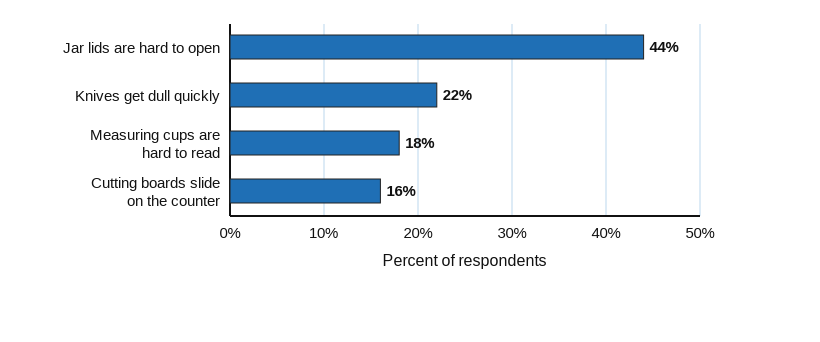
Kenji Watanabe's small company in Osaka designs kitchen tools. Kenji can afford to develop only one new product this year. He surveyed 400 home cooks and asked each to name the one kitchen problem that bothers them most. The figure shows the results.
Biggest kitchen problem named by 400 home cooks
Horizontal bar chart titled "Biggest Kitchen Problem Named by 400 Home Cooks (percent of respondents)". Jar lids are hard to open: 44%. Knives get dull quickly: 22%. Measuring cups are hard to read: 18%. Cutting boards slide on the counter: 16%.
Based on the data, which decision would best help Kenji’s company achieve problem-solution fit with the largest group of potential customers?
Show answer and explanation
Correct answer: D
Businesses identify customer problems and develop products to address them, but they must choose which problems and customers to focus on. With budget for only one product, the jar problem (44%, or 176 of 400 cooks) offers problem-solution fit with the largest group.
A.The data do not show that every cook has this problem; only 22% of respondents named dull knives as their biggest problem.
B.Businesses cannot satisfy all potential customers; they must select which problems to focus on. Kenji can develop only one product, and the data point to one clearly leading problem.
C.The survey contains no information about competition, and 16% is the smallest group of potential customers, not the largest.
D.Correct: Jar lids were named by 44% of respondents (176 of 400 cooks), the largest group, so a product that solves this problem best matches the most potential customers.
Question 5Easy
Lucía Fernández noticed that nurses finishing night shifts at a hospital in Monterrey could not find hot meals after midnight, because nearby restaurants closed at 10 p.m. She opened a food stall beside the hospital that serves hot soups and tamales from midnight to 6 a.m.
Which of the following best describes how Lucía's stall creates value?
Show answer and explanation
Correct answer: A
Value is the worth or benefit of a product to customers, and value creation occurs when a business provides a product that responds to customers' needs. Lucía's stall meets the nurses' need for hot food at a time when no restaurant is open.
A.Correct: Value creation occurs when a business provides a product that responds to customers’ problems, needs, and wants; the stall meets the nurses’ need for hot food after midnight.
B.Charging more than the cost to produce describes value capture, not value creation.
C.Revenue benefits Lucía’s business; value creation describes the benefit the product provides to customers.
D.Lucía’s schedule is a benefit to the owner, not the worth of the product to customers.
Question 6Easy
Nadia Petrova makes ceramic mugs in her apartment in Sofia and sells them only through her own online shop. She has no employees and no physical store.
Which of the following statements about Nadia's shop is most accurate?
Show answer and explanation
Correct answer: C
A business is an organization or entity that produces and distributes goods and/or services. A business can be any size, based on geographic reach, employees, or revenue, and can serve customers face-to-face or virtually, so Nadia's online mug shop is a business.
A.A business can be any size, including by number of employees; a one-person operation can be a business.
B.Businesses can serve customers face-to-face or virtually, so selling only online does not prevent the shop from being a business.
C.Correct: A business is an organization or entity that produces and distributes products. Nadia makes and sells mugs, and her small size and online sales do not change that.
D.A business can be any size, including by revenue; there is no minimum revenue required to be a business.
Question 7Hard
Leila Haddad's software company sells shift-scheduling software to hospitals. Each hospital's purchasing department decides whether to buy the software, and the hospital's nurses use the software every day to view and swap their work shifts. Leila wants to improve the software so that more hospitals will buy it.
Which of the following approaches best accounts for both the company's customers and its consumers?
Show answer and explanation
Correct answer: B
A customer purchases a product, while a consumer uses it whether or not they are the buyer. Hospitals buy the software through purchasing departments (customers), and nurses use it daily (consumers), so gathering information from both groups best identifies the problems and needs the software must address.
A.The nurses use the software, so they are consumers; the hospitals’ purchasing departments pay for it.
B.Correct: The hospitals (through their purchasing managers) are the customers who buy the software, and the nurses are the consumers who use it. Learning about both groups’ problems and needs addresses both.
C.A consumer is the person who uses a product, whether or not they are the buyer; this approach ignores the nurses, who are the consumers.
D.Patients do not buy or use the scheduling software, so they are neither its customers nor its consumers.
Question 8Easy
Ama Owusu runs StoryNest, a small online business in Accra that sells monthly subscriptions to audio stories for children ages 4 to 8. Before launching, Ama surveyed 150 parents and found that many wanted a bedtime activity for their children that did not involve looking at a screen. Parents buy the subscriptions on StoryNest's website, and their children listen to the stories on a small speaker at bedtime. StoryNest offers three plans.
Plan
Monthly price per subscriber
Monthly cost to produce and deliver the plan per subscriber
Basic (4 new stories)
$5.00
$3.50
Family (10 new stories, up to 3 children)
$9.00
$9.60
Premium (unlimited stories)
$12.00
$8.40
In the scenario, which of the following correctly identifies StoryNest's customers and consumers?
Show answer and explanation
Correct answer: B
A customer is the one who purchases a product, and a consumer is the one who uses it, whether or not they are the buyer. Parents pay for StoryNest subscriptions, so they are the customers; children listen to the stories, so they are the consumers.
A.This reverses the terms. A customer purchases the product; the parents, not the children, buy the subscriptions.
B.Correct: A customer is the individual who purchases a good or service, and a consumer is the individual who uses it, whether or not they are the buyer.
C.The parents buy the subscriptions but do not listen to the stories at bedtime; the children use the product, so they are the consumers.
D.Being the intended user makes the children consumers, not customers; the parents are the ones who pay.
Question 9Moderate
Ama Owusu runs StoryNest, a small online business in Accra that sells monthly subscriptions to audio stories for children ages 4 to 8. Before launching, Ama surveyed 150 parents and found that many wanted a bedtime activity for their children that did not involve looking at a screen. Parents buy the subscriptions on StoryNest's website, and their children listen to the stories on a small speaker at bedtime. StoryNest offers three plans.
Plan
Monthly price per subscriber
Monthly cost to produce and deliver the plan per subscriber
Basic (4 new stories)
$5.00
$3.50
Family (10 new stories, up to 3 children)
$9.00
$9.60
Premium (unlimited stories)
$12.00
$8.40
Which of the following best explains how StoryNest achieved problem-solution fit?
Show answer and explanation
Correct answer: A
Problem-solution fit means a business has identified a customer problem, need, or want and developed a product that addresses it. StoryNest's survey revealed parents' want for a screen-free bedtime activity, and its audio stories respond directly to that want.
A.Correct: Problem-solution fit is achieved when a business identifies a customer problem, need, or want and develops a product that addresses it. Ama found the want through her survey and built audio stories that require no screen.
B.Offering several plans is a pricing decision, and businesses cannot satisfy all potential customers; they must choose which problems and customers to focus on.
C.Serving customers virtually describes how the business operates, not how its product addresses a customer problem, need, or want.
D.Charging more than the cost to produce describes value capture, not problem-solution fit.
Question 10Moderate
Ama Owusu runs StoryNest, a small online business in Accra that sells monthly subscriptions to audio stories for children ages 4 to 8. Before launching, Ama surveyed 150 parents and found that many wanted a bedtime activity for their children that did not involve looking at a screen. Parents buy the subscriptions on StoryNest's website, and their children listen to the stories on a small speaker at bedtime. StoryNest offers three plans.
Plan
Monthly price per subscriber
Monthly cost to produce and deliver the plan per subscriber
Basic (4 new stories)
$5.00
$3.50
Family (10 new stories, up to 3 children)
$9.00
$9.60
Premium (unlimited stories)
$12.00
$8.40
Based on the table, for which plan or plans is StoryNest NOT achieving value capture?
Show answer and explanation
Correct answer: C
Value capture occurs when a business charges a higher price than the product cost to produce. Price minus cost is $1.50 for Basic, -$0.60 for Family, and $3.60 for Premium, so only the Family plan fails to capture value.
A.Premium has the highest cost, but its $12.00 price is $3.60 higher than its $8.40 cost, so StoryNest captures value on it.
B.Basic has the lowest price, but its $5.00 price is $1.50 higher than its $3.50 cost, so StoryNest captures value on it.
C.Correct: Value capture occurs only when the price is higher than the cost to produce. The Family plan costs $9.60 to produce and deliver but sells for only $9.00, a difference of -$0.60 per subscriber.
D.The Family plan does not capture value, but the Basic plan does: its $5.00 price exceeds its $3.50 cost.
Unit 1 of every course is free
Get lesson videos, unit tests, and progress tracking that shows which topics need work.
Unlock all eight AP courses for $10 a month or $40 through June 30, 2027. One-time payment, no auto-renewal.Pricing