Motion can be shown in words, equations, graphs and diagrams. Practice reading slopes and areas on position–time, velocity–time and acceleration–time graphs and matching graphs to a described motion.
Free practice set · 3 multiple-choice questions · no sign-up needed
Score0 / 0
Question 1Easy
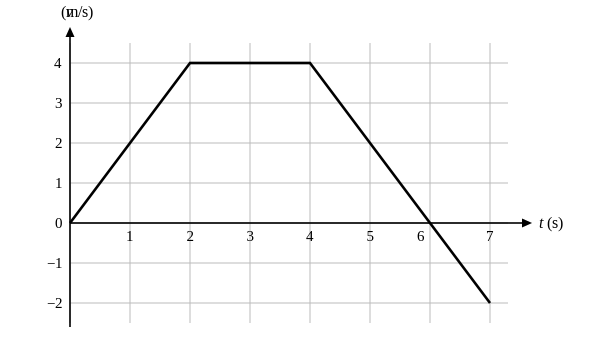
Graph of velocity v in meters per second versus time t in seconds, with gridlines every 1 s and every 1 m/s. The vertical axis runs from -2 to 4 m/s and the horizontal axis from 0 to 7 s. The graph is made of straight segments: from 0 m/s at t = 0 rising to 4 m/s at t = 2 s; constant at 4 m/s from t = 2 s to t = 4 s; decreasing from 4 m/s at t = 4 s through 0 at t = 6 s to -2 m/s at t = 7 s.
The graph shows the velocity v of a cart moving along a straight track as a function of time t. What is the cart's displacement from t=0 to t=7s?
Show answer and explanation
Correct answer: A
The area under a velocity–time graph gives displacement, with area below the time axis counting as negative. The area above the axis is 16m and the area below is 1m, so the displacement is 15m.
A.Correct. 16m of positive area minus 1m of negative area.
B.This ignores the part of the graph below the axis from 6s to 7s, when the cart moves backward.
C.This adds the area below the axis as positive; that gives the distance traveled, not the displacement.
D.This multiplies the maximum velocity 4m/s by 7s, as if the velocity were constant.
Question 2Moderate
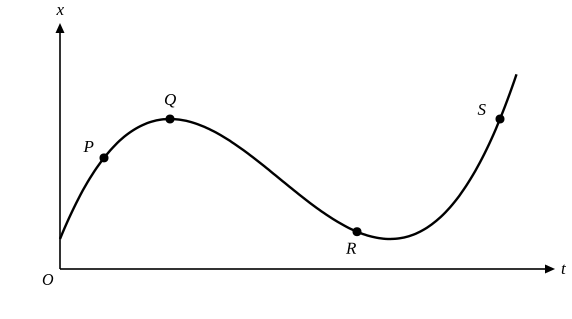
Graph of position x versus time t, origin O, no numerical scale. The curve starts above the origin, rises with decreasing slope to a maximum, falls to a minimum, then rises steeply. Point P is on the rising part before the maximum, where the curve is concave down. Point Q is at the maximum, where the curve is momentarily horizontal. Point R is on the falling part after the maximum, just before the minimum, where the curve is concave up. Point S is on the final rising part after the minimum, where the curve is concave up.
The graph shows the position x of an object moving along the x-axis as a function of time t. At which labeled point is the object moving in the −x-direction and slowing down?
Show answer and explanation
Correct answer: C
Moving in the −x-direction requires a negative slope, and slowing down requires the acceleration to be opposite the velocity, here positive (concave up). Only at R is the curve both decreasing and concave up.
A.At P the object is slowing down, but the slope is positive, so it moves in the +x-direction.
B.At Q the slope is zero, so the object is momentarily at rest rather than moving in the −x-direction.
C.Correct. The negative slope gives v<0 and the upward concavity gives a>0; opposite signs mean the object is slowing down.
D.At S the curve is concave up, but the slope is positive; the object moves in the +x-direction and is speeding up.
Question 3Hard
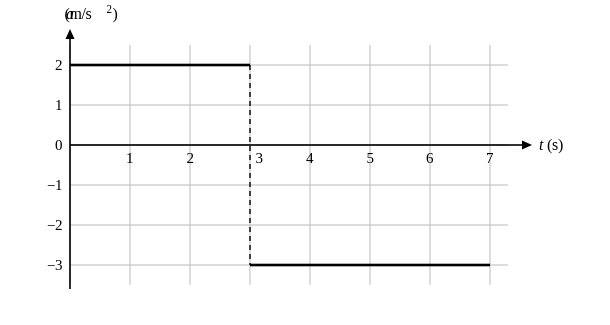
Graph of acceleration a in meters per second squared versus time t in seconds, with gridlines every 1 s and every 1 m/s^2. The vertical axis runs from -3 to 2 m/s^2 and the horizontal axis from 0 to 7 s. The acceleration is constant at +2 m/s^2 from t = 0 to t = 3 s, then constant at -3 m/s^2 from t = 3 s to t = 7 s. A dashed vertical line at t = 3 s joins the two levels.
An object moves along the x-axis. Its acceleration a as a function of time t is shown in the graph. At t=0, the object is at x=0 and has velocity −2.0m/s. What is the object's position at t=7s?
Show answer and explanation
Correct answer: B
Treat each constant-acceleration interval separately, carrying the velocity at t=3s into the second interval. The object gains 3m in the first 3s, turns around during the second interval, and ends 5m on the negative side of the origin.
A.This is the area under the acceleration graph, 6−12=−6, which is the change in velocity in m/s, not a position.
B.Correct. x(3)=3m and v(3)=4m/s; the second interval adds −8m.
C.This ignores the initial velocity and treats the object as starting from rest.
D.This uses an initial velocity of +2.0m/s instead of −2.0m/s.
Unit 1 of every course is free
This topic has 14 more practice questions in adaptive review, plus lesson videos, unit quizzes, and progress tracking that shows which topics need work.
Unlock all eight AP courses for $10 a month or $40 through June 30, 2027. One-time payment, no auto-renewal.Pricing