AP Physics C: Electricity and Magnetism · Unit 8 · Topic 8.1
8.1 Electric Charge and Electric Force: Practice Questions
Like charges repel and unlike charges attract with a force given by Coulomb's law. Practice finding the size and direction of electric forces and adding forces from several charges as vectors.
Free practice set · 4 multiple-choice questions · no sign-up needed
Score0 / 0
Question 1Easy
Two small charged spheres are held a fixed distance apart in vacuum, and each exerts an electric force of magnitude F on the other. The spheres are then submerged, at the same separation and with the same charges, in an insulating liquid whose electric permittivity is ε=4ε0.
What is the magnitude of the electric force each sphere now exerts on the other?
Show answer and explanation
Correct answer: B
The permittivity of the medium appears in the denominator of Coulomb's law. A medium with four times the permittivity of vacuum reduces the force between the same charges at the same separation to one fourth.
A.Squares the factor of 4 as if permittivity entered the law like the separation does.
B.Correct. F∝1/ε, so multiplying ε by 4 divides the force by 4.
C.Assumes the force depends only on the charges and separation and ignores the medium.
D.Places the permittivity in the numerator, as if a higher-permittivity medium strengthened the interaction.
Question 2Easy
Two protons are a distance r apart, far from any other objects. Let R be the ratio of the magnitude of the electric force between them to the magnitude of the gravitational force between them.
If the separation is increased to 2r, which of the following correctly describes how R changes and why?
Show answer and explanation
Correct answer: C
Coulomb's law and Newton's law of gravitation are both inverse-square laws. When the separation changes, both forces change by the same factor, so their ratio depends only on the charges and masses.
A.Applies the inverse-square decrease to the electric force but forgets that the gravitational force decreases by the same factor.
B.The gravitational force does depend on mass, but the masses do not change; neither force changes by a factor of 2.
C.Correct. Both forces scale as 1/r2, so the r dependence cancels in the ratio.
D.Both forces fall off as 1/r2; neither decreases faster than the other.
Question 3Moderate
A point charge +4q is fixed at x=0 and a point charge +q is fixed at x=d. A third point charge is placed on the x-axis between them.
At what position x is the net electric force on the third charge zero?
Show answer and explanation
Correct answer: C
The third charge must sit closer to the smaller charge so that the larger charge's greater strength is offset by its greater distance. Since the forces scale as q/r2, the distances must be in the ratio 4:1=2:1, placing the point at 2d/3.
A.Inverts the distance ratio, placing the charge closer to the larger charge where that force would dominate.
B.Assumes the midpoint, which would be correct only if the two fixed charges were equal.
C.Correct. Distances from the 4q and q charges must be in the ratio 2:1, which gives x=2d/3.
D.Uses the charge ratio 4:1 for the distances instead of its square root, as if the force varied as 1/r.
Question 4Hard
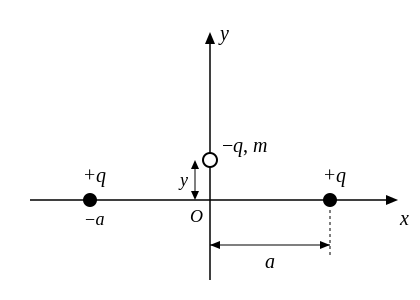
An x-y coordinate system with origin O. Fixed point charges +q sit on the x-axis at x = −a and x = +a. A particle of mass m and charge −q is on the positive y-axis a small distance y above O. A dimension arrow marks the distance a from O to the right-hand charge.
Two point charges, each +q, are fixed on the x-axis at x=−a and x=+a, as shown. A particle of mass m and charge −q is released from rest on the y-axis at a small distance y≪a from the origin O. Gravity is negligible, and k=4πε01.
The particle oscillates along the y-axis. What is the period of its oscillation?
Show answer and explanation
Correct answer: B
The two attractive forces have horizontal components that cancel and vertical components that point back toward the origin. For small displacements the net force is proportional to y, giving simple harmonic motion with an effective spring constant 2kq2/a3.
A.Includes the restoring component from only one of the two fixed charges.
B.Correct. The net restoring force is −(2kq2/a3)y, so T=2πma3/(2kq2).
C.Uses 2a, the separation of the fixed charges, as the distance from each fixed charge to the particle.
D.Gives 1/ω rather than the period; it omits the factor 2π.
Unit 1 of every course is free
This topic has 9 more practice questions in adaptive review, plus lesson videos, unit quizzes, and progress tracking that shows which topics need work.
Unlock all eight AP courses for $10 a month or $40 through June 30, 2027. One-time payment, no auto-renewal.Pricing