1.6 Marginal Analysis and Consumer Choice: Practice Questions
Optimal choices are made at the margin. Practice using marginal benefit and marginal cost, diminishing marginal utility, and the utility-maximizing rule (MU per dollar equal across goods) for a consumer with a budget.
Free practice set · 12 multiple-choice questions · no sign-up needed
Score0 / 0
Question 1Easy
Suppose that a consumer purchases two goods X and Y and that the marginal utility of X is MUx, the total utility of X is TUx, the marginal utility of Y is MUy, and the total utility of Y is TUy. If the prices of X and Y are Px and Py, respectively, which of the following expressions defines consumer equilibrium?
Show answer and explanation
Correct answer: D
A consumer is in equilibrium when the marginal utility per dollar spent is the same for both goods.
A.Equal total utilities are not required for utility maximization.
B.Equal marginal utilities are optimal only if the two prices are equal.
C.The rule uses marginal, not total, utility per dollar.
D.Correct. Equal marginal utility per dollar means no reallocation of spending can raise total utility.
E.This expression has no economic meaning as an optimality condition.
Question 2Easy
Assume the following utility schedule for Aaliyah's ice cream consumption. If she consumes 6 units, what is the value of her total utility from consuming ice cream?
Quantity Consumed
Marginal Utility
1
8
2
6
3
4
4
2
5
0
6
-2
Show answer and explanation
Correct answer: C
Total utility is the sum of the marginal utilities of all units consumed: 8+6+4+2+0+(−2)=18.
A.22 does not correspond to any cumulative total in the schedule; the totals are 8, 14, 18, 20, 20, 18.
B.20 is total utility after 4 or 5 units, before the sixth unit subtracts 2.
C.Correct. Adding the six marginal utilities gives 8+6+4+2+0−2=18.
D.0 is the marginal utility of the fifth unit, not a total.
E.-2 is the marginal utility of the sixth unit, not total utility.
Question 3Easy
Which of the following is a key assumption of consumer choice theory?
Show answer and explanation
Correct answer: B
The model of rational consumer choice assumes consumers choose so as to maximize total utility subject to their constraints.
A.Implicit and explicit costs are used in analyzing firms' costs and profit, not as a consumer decision rule.
B.Correct. Utility maximization is the central assumption of consumer choice theory.
C.Consumers buy less of inferior goods as income rises, so this is not assumed.
D.The theory assumes diminishing, not increasing, marginal utility.
E.This describes diminishing marginal returns in production, not consumer choice.
Question 4Easy
Marginal analysis suggests that an individual will consume one additional unit of a good if the
Show answer and explanation
Correct answer: E
Marginal analysis compares the additional benefit of one more unit with its additional cost; consume it when marginal benefit exceeds marginal cost.
A.Sunk costs are irrelevant to marginal decisions.
B.This compares totals, not the extra benefit and cost of one more unit.
C.Total benefit can exceed total cost even when the next unit costs more than it is worth.
D.In this case the extra unit reduces net benefit and should not be consumed.
E.Correct. An extra unit is worth consuming when its marginal benefit exceeds its marginal cost.
Question 5Easy
When marginal utility is falling but positive, total utility will
Show answer and explanation
Correct answer: E
Positive marginal utility means total utility is rising; falling marginal utility means each increase is smaller than the last.
A.Total utility decreases only when marginal utility is negative.
B.Total utility decreases only when marginal utility is negative.
C.Total utility is constant only when marginal utility is zero.
D.Total utility rises at an increasing rate only when marginal utility is rising.
E.Correct. Total utility increases, but by smaller and smaller amounts.
Question 6Easy
The information below shows the marginal utilities a student receives from the consumption of pizza and pens. Assume that the marginal utility of each good is independent of the quantity of the other good consumed.
Units of Pizza
Marginal Utility of Pizza
Units of Pens
Marginal Utility of Pens
1
20
1
8
2
18
2
7
3
16
3
6
4
14
4
5
5
12
5
4
6
10
6
3
7
9
7
2
8
8
8
1
If the student purchases 2 units of pizza and 2 units of pens, the student's total utility will be
Show answer and explanation
Correct answer: E
Total utility is the sum of the marginal utilities of every unit consumed: (20+18)+(8+7)=53 utils.
A.4 is the number of units purchased, not utility.
B.25 adds only the marginal utilities of the second units (18+7).
C.28 adds only the marginal utilities of the first units (20+8).
D.50 does not match any correct sum; it omits part of the pens' utility.
E.Correct. 20+18+8+7=53.
Question 7Easy
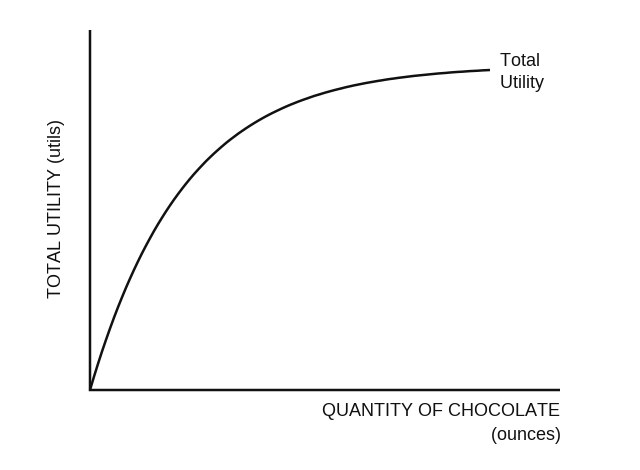
A graph with TOTAL UTILITY (utils) on the vertical axis and QUANTITY OF CHOCOLATE (ounces) on the horizontal axis. A single curve labeled Total Utility starts at the origin, rises steeply at first, and becomes progressively flatter as the quantity of chocolate increases.
The diagram above shows Sally's utility function for chocolate. Her utility function illustrates the principle of
Show answer and explanation
Correct answer: B
The total utility curve rises at a decreasing rate; its slope is marginal utility, which falls as more chocolate is consumed.
A.The graph shows one good only, so no trade-off between alternatives is shown.
B.Correct. The flattening slope shows each additional ounce adds less utility.
C.Income and substitution effects concern responses to price changes, which the graph does not show.
D.Increasing opportunity cost is shown by a bowed-out production possibilities curve.
E.No budget constraint or second good appears in the graph.
Question 8Easy
According to the theory of consumer behavior, which of the following decreases first as additional units of a product are consumed?
Show answer and explanation
Correct answer: C
Marginal utility begins to fall first; average utility falls only after marginal utility drops below it, and total utility falls only after marginal utility becomes negative.
A.Total utility declines only once marginal utility turns negative, which happens later.
B.Average utility declines only after marginal utility has fallen below the average.
C.Correct. Diminishing marginal utility sets in before average or total utility declines.
D.Marginal physical product is a production concept, not part of consumer behavior theory.
E.Total physical product is a production concept, not part of consumer behavior theory.
Question 9Moderate
Assume that a consumer spends all her income on the purchase of two goods. If the consumer's income doubles and the prices of the two goods also double, the quantity of the two goods purchased will
Show answer and explanation
Correct answer: D
Doubling income and both prices leaves the set of affordable bundles and the relative price unchanged, so the utility-maximizing bundle is unchanged.
A.Quantities would double only if income doubled with prices unchanged.
B.Nothing has made the consumer able to afford more than before.
C.Purchasing power is unchanged, so there is no increase.
D.Correct. The budget constraint is identical, so the same bundle is chosen.
E.The result follows from the unchanged budget constraint, not from a demand curve's slope.
Question 10Moderate
Hours at the Library
Total Benefit
Total Cost
1
12
10
2
20
13
3
26
18
4
31
25
5
33
33
6
35
42
The table provided shows the total benefits and costs of studying at the library. If the student is rational, the optimal number of hours to spend at the library is
Show answer and explanation
Correct answer: B
Net benefit (total benefit minus total cost) is 2, 7, 8, 6, 0, -7 for hours 1 to 6, so it is greatest at 3 hours; the fourth hour has marginal benefit 5 but marginal cost 7.
A.At 2 hours net benefit is 7; the third hour adds benefit 6 at cost 5, so the student should continue.
B.Correct. Net benefit peaks at 26−18=8, and the next hour's marginal cost (7) exceeds its marginal benefit (5).
C.The fourth hour adds 5 in benefit but 7 in cost, lowering net benefit to 6.
D.At 5 hours total benefit equals total cost, so net benefit is zero.
E.At 6 hours total cost exceeds total benefit by 7.
Question 11Moderate
An art student spends all of her income on pencils and drawing pads. The student currently buys 30 pencils at $1 each and 10 pads at $5 each. If the marginal utility of the 30th pencil is 100 utils and the marginal utility of the 10th pad is 400 utils, to maximize utility the student should change her purchases of pencils and pads in which of the following ways?
Show answer and explanation
Correct answer: C
Marginal utility per dollar is 100/1=100 for pencils and 400/5=80 for pads, so a dollar moved from pads to pencils raises total utility.
A.Buying more pads with unchanged pencils is not affordable, and pads have the lower marginal utility per dollar.
B.She already spends all her income, so she cannot buy more of both.
C.Correct. Pencils give 100 utils per dollar versus 80 for pads, so she should buy more pencils and fewer pads.
D.This moves spending toward the good with the lower marginal utility per dollar.
E.Buying less of both leaves income unspent and lowers total utility.
Question 12Moderate
Quantity of Apples
Total Benefit ($)
1
10
2
18
3
24
4
28
5
30
6
31
The table above shows the total benefit Tony gets from eating different quantities of apples. If apples cost $3 each, how many should he buy to maximize his consumer surplus?
Show answer and explanation
Correct answer: D
Marginal benefit is 10, 8, 6, 4, 2, 1; Tony buys each apple whose marginal benefit is at least the $3 price, which is the first four, giving a surplus of 28−12=16.
A.Surplus is 10−3=7; the second apple adds 8 for a cost of 3.
B.Surplus is 18−6=12; the third apple adds 6 for a cost of 3.
C.Surplus is 24−9=15; the fourth apple adds 4 for a cost of 3.
D.Correct. Surplus is 28−12=16, the maximum; the fifth apple would add only 2 for a cost of 3.
E.Surplus falls to 30−15=15 because the fifth apple's marginal benefit (2) is less than its price (3).
Unit 1 of every course is free
This topic has 24 more practice questions in adaptive review, plus lesson videos, unit quizzes, and progress tracking that shows which topics need work.
Unlock all eight AP courses for $10 a month or $40 through June 30, 2027. One-time payment, no auto-renewal.Pricing