1.4 Comparative Advantage and Trade: Practice Questions
Specialization and trade based on comparative advantage let both sides consume beyond their own PPC. Practice computing opportunity costs from output and input tables, identifying absolute and comparative advantage, and finding terms of trade that benefit both parties.
Free practice set · 10 multiple-choice questions · no sign-up needed
Score0 / 0
Question 1Easy
Country
Opportunity Cost of 1 Ton of Apples
Opportunity Cost of 1 Ton of Oranges
X
1 ton of oranges
1 ton of apples
Y
2 tons of oranges
0.5 ton of apples
The table above shows the opportunity costs of producing apples and oranges in Countries X and Y. Which of the following can be concluded based on the data given in the table?
Show answer and explanation
Correct answer: E
The table gives opportunity costs directly. A ton of apples costs Country X 1 ton of oranges and costs Country Y 2 tons, so X has the comparative advantage in apples. Absolute advantage cannot be read from opportunity costs.
A.Opportunity costs say nothing about total productivity, so absolute advantage cannot be concluded.
B.A country cannot have a comparative advantage in both goods; Y has it only in oranges.
C.Opportunity costs say nothing about total productivity, so absolute advantage cannot be concluded.
D.X's opportunity cost of oranges (1 ton of apples) is higher than Y's (0.5 ton of apples).
E.Correct. X's opportunity cost of apples (1 ton of oranges) is lower than Y's (2 tons of oranges).
Question 2Easy
If nations specialize according to their comparative advantage and engage in international trade with each other, each nation can
Show answer and explanation
Correct answer: B
Specialization and trade let each nation consume a combination of goods that lies outside its own PPC, even though production stays on the PPC.
A.Incorrect. Production cannot exceed the PPC; trade changes consumption possibilities, not production possibilities.
B.Correct. Trade allows consumption beyond the PPC.
C.Incorrect. Trade does not by itself increase resources or technology, so the PPC does not shift.
D.Incorrect. Specialization makes nations more interdependent, not more self-sufficient.
E.Incorrect. A specializing nation produces more of one good and less of the other.
Question 3Easy
Cindy and Martin both sew t-shirts in a small factory. Using the same resources, Martin can sew twelve t-shirts and Cindy can sew nine t-shirts in one day. Which of the following can be concluded from the given information?
Show answer and explanation
Correct answer: D
With the same resources Martin sews 12 t-shirts and Cindy sews 9, so Martin has the absolute advantage. Nothing is said about a second good, so opportunity costs and comparative advantage cannot be determined.
A.Opportunity cost requires knowing what else each person could produce; only one good is given.
B.Comparative advantage depends on opportunity cost, which cannot be computed from one good.
C.Comparative advantage depends on opportunity cost, which cannot be computed from one good; producing more does not establish it.
D.Correct. Martin produces more t-shirts (12 > 9) with the same resources.
E.Cindy produces fewer t-shirts (9 < 12) with the same resources.
Question 4Moderate
In the country Beta it takes two hours of labor to produce a unit of tea and four hours of labor to produce a unit of bread. In the country Zeta it takes three hours of labor to produce a unit of tea and nine hours of labor to produce a unit of bread. Which of the following is true?
Show answer and explanation
Correct answer: D
These are input data (fewer hours is better). A unit of bread costs Beta 4/2 = 2 units of tea and costs Zeta 9/3 = 3 units of tea, so Beta has the lower opportunity cost and the comparative advantage in bread. Zeta has the comparative advantage in tea.
A.Zeta uses more labor hours for both goods, so Beta has both absolute advantages.
B.Zeta has the comparative advantage in tea (1/3 < 1/2 bread) but not the absolute advantage (3 h > 2 h).
C.Beta has the absolute advantage in tea, but its opportunity cost of tea (1/2 bread) is higher than Zeta's (1/3 bread).
D.Correct. Beta gives up 2 tea per bread, versus 3 tea for Zeta.
E.Trade follows comparative advantage: Beta exports bread and imports tea.
Question 5Moderate
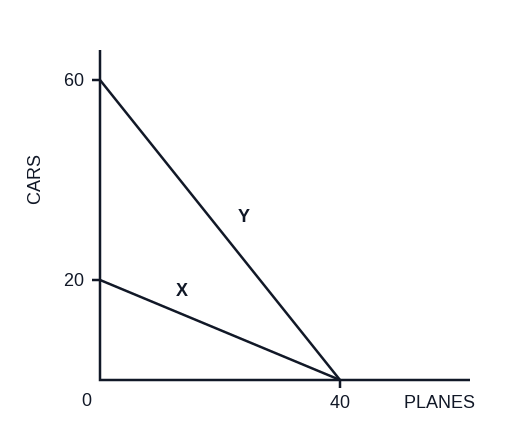
Graph with CARS on the vertical axis and PLANES on the horizontal axis showing two straight-line production possibilities curves. Country X's line runs from 20 cars on the vertical axis to 40 planes on the horizontal axis. Country Y's line runs from 60 cars on the vertical axis to the same 40 planes on the horizontal axis.
The diagram above shows the production possibilities curves for two countries, Country X and Country Y. Assume that both countries use equal amounts of resources in production. If the two countries engage in trade, both would be better off under which of the following conditions?
Show answer and explanation
Correct answer: E
Country Y gives up only 32 of a plane per car, while Country X gives up 2 planes per car. Y has the comparative advantage in cars and X in planes, so both gain when Y specializes in cars.
A.Incorrect. X does not have an absolute advantage in either good: it makes fewer cars than Y and the same number of planes.
B.Incorrect. No country can have a comparative advantage in both goods.
C.Incorrect. Y, not X, has the absolute advantage in cars (60 versus 20).
D.Incorrect. X's opportunity cost of a car (2 planes) is higher than Y's, so X has the comparative advantage in planes.
E.Correct. Y's opportunity cost of a car is 32 plane, lower than X's 2 planes.
Question 6Moderate
The table provided shows the number of labor hours required to produce a cell phone or a unit of lumber in Estonia and in Finland.
Country
Cell Phone
Unit of Lumber
Estonia
20 hours
5 hours
Finland
20 hours
4 hours
Based on the information in the table, which of the following is true?
Show answer and explanation
Correct answer: C
This is an input table (fewer hours is better). Finland needs 4 hours per unit of lumber and Estonia needs 5, so Finland has the absolute advantage in lumber. Finland also has the comparative advantage in lumber, and Estonia has the comparative advantage in cell phones.
A.Estonia's opportunity cost of lumber (5/20 = 1/4 phone) is higher than Finland's (4/20 = 1/5 phone).
B.Finland's opportunity cost of a cell phone (5 lumber) is higher than Estonia's (4 lumber).
C.Correct. Finland uses fewer labor hours per unit of lumber (4 < 5).
D.Estonia uses more hours for lumber and has the higher opportunity cost of lumber, so it has neither advantage.
E.Although both need 20 hours per phone (no absolute advantage), Estonia gives up less lumber per phone (4 < 5) and so has the comparative advantage.
Question 7Moderate
Units of Manufactured Goods and Service Goods Produced Using One Hour of Labor
Country
Manufactured Goods
Service Goods
A
100 units
300 units
B
75 units
150 units
According to the information in the table above, which of the following statements is true if both countries have the same number of workers?
Show answer and explanation
Correct answer: B
This is an output table. Country A produces more of both goods per hour, so it has the absolute advantage in both. One unit of service goods costs A 1/3 unit of manufactured goods and costs B 1/2 unit, so A has the comparative advantage in service goods and B has it in manufactured goods.
A.A has the absolute advantage in manufactured goods, but its opportunity cost of manufactured goods (3 service) is higher than B's (2 service).
B.Correct. A produces more manufactured goods (100 > 75), and A's opportunity cost of service goods (1/3) is lower than B's (1/2).
C.B has no absolute advantage, but its comparative advantage is in manufactured goods, not service goods.
D.A has the absolute advantage in service goods, but its comparative advantage is in service goods, not manufactured goods.
E.B produces fewer manufactured goods per hour (75 < 100), and the table is enough to determine comparative advantage.
Question 8Moderate
Suppose that in one week Sam can knit 5 sweaters or make 4 blankets and Rob can knit 10 sweaters or make 6 blankets. Which of the following is true?
Show answer and explanation
Correct answer: C
This is an output table. A blanket costs Sam 5/4 = 1.25 sweaters and costs Rob 10/6 (about 1.67) sweaters, so Sam has the lower opportunity cost and the comparative advantage in blankets, even though Rob produces more of both goods.
A.Rob makes more blankets per week (6 > 4).
B.Rob knits more sweaters per week (10 > 5).
C.Correct. Sam gives up 1.25 sweaters per blanket, versus about 1.67 for Rob.
D.Sam's opportunity cost of a sweater (0.8 blanket) is higher than Rob's (0.6 blanket).
E.Sam has no absolute advantage, but he does have a comparative advantage in blankets.
Question 9Hard
The chart below shows the number of resource units the countries Gamma and Omega must use to produce one unit of food or one unit of clothing.
Gamma
Omega
Food
10 resource units
5 resource units
Clothing
9 resource units
3 resource units
Which of the following statements is true according to the chart above?
Show answer and explanation
Correct answer: B
This is an input table (fewer resource units is better). A unit of food costs Gamma 10/9 units of clothing and costs Omega 5/3 units of clothing, so Gamma has the comparative advantage in food. A unit of clothing costs Omega 3/5 unit of food and costs Gamma 9/10, so Omega has the comparative advantage in clothing.
A.This reverses the comparative advantages: Gamma's opportunity cost of clothing (0.9 food) is higher than Omega's (0.6 food).
B.Correct. Gamma has the lower opportunity cost of food (10/9 < 5/3 clothing) and Omega has the lower opportunity cost of clothing (3/5 < 9/10 food).
C.Opportunity costs differ, so specialization and trade allow both to consume more than self-sufficiency.
D.Omega does have the absolute advantage in both goods, but gains from trade depend on comparative advantage, so Omega can still benefit.
E.Gamma uses more, not fewer, resources for both goods, and the conclusion is also wrong.
Question 10Hard
Palm Leaves
Coconuts
Robert
8
2
Frank
10
5
The table above shows the maximum number of palm leaves or coconuts that Robert and Frank can pick respectively in a single day. Which of the following is true?
Show answer and explanation
Correct answer: D
This is an output table. A coconut costs Robert 4 palm leaves and costs Frank 2 palm leaves, so Frank has the comparative advantage in coconuts and Robert in palm leaves. Both gain only if the price of a coconut lies between 2 and 4 palm leaves; 3 palm leaves per coconut is in that range.
A.Robert's opportunity cost of a coconut (4 palm leaves) is higher than Frank's (2 palm leaves).
B.Frank's opportunity cost of a palm leaf (1/2 coconut) is higher than Robert's (1/4 coconut).
C.1 palm leaf per coconut is below Frank's opportunity cost of 2 palm leaves, so Frank would lose by selling coconuts.
D.Correct. 3 palm leaves per coconut lies between the opportunity costs of 2 (Frank) and 4 (Robert).
E.5 palm leaves per coconut is above Robert's own opportunity cost of 4 palm leaves, so Robert would lose by buying coconuts.
Unit 1 of every course is free
This topic has 12 more practice questions in adaptive review, plus lesson videos, unit quizzes, and progress tracking that shows which topics need work.
Unlock all eight AP courses for $10 a month or $40 through June 30, 2027. One-time payment, no auto-renewal.Pricing