Demand describes how much buyers are willing and able to purchase at each price. Practice telling a movement along the demand curve from a shift of the curve, and identifying the determinants of demand such as income, tastes and the prices of related goods.
Free practice set · 13 multiple-choice questions · no sign-up needed
Score0 / 0
Question 1Moderate
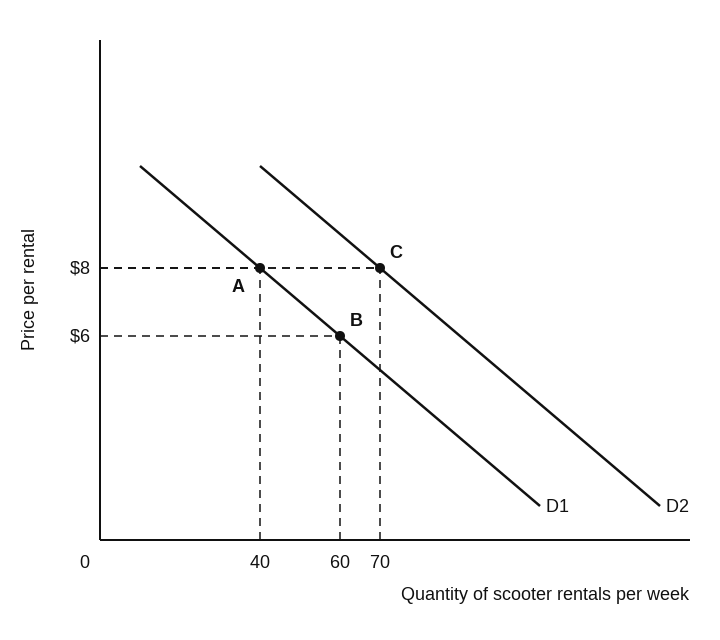
Graph of the market for scooter rentals with price per rental on the vertical axis and quantity of scooter rentals per week on the horizontal axis. Two parallel downward-sloping demand curves, D1 and D2, with D2 to the right of D1. Point A is on D1 at a price of $8 and a quantity of 40. Point B is on D1 at a price of $6 and a quantity of 60. Point C is on D2 at a price of $8 and a quantity of 70.
The graph shows demand in the market for scooter rentals. Scooter rentals are a normal good. Which of the following best explains a movement from point A to point C?
Show answer and explanation
Correct answer: A
From A to C the price stays at $8 while the quantity demanded rises from 40 to 70, so the whole demand curve has shifted right from D1 to D2. A change in a nonprice determinant causes this; higher income raises demand for a normal good.
A.Correct: higher income increases demand for a normal good, shifting D1 to D2 at every price, such as from A to C.
B.A lower price of the good itself moves consumers along D1 from A to B; it does not shift the curve.
C.A higher price of a complement reduces demand, shifting the curve to the left, not to the right.
D.A higher price of the good moves consumers up along the same demand curve and lowers quantity demanded.
E.A cheaper substitute pulls buyers away, decreasing demand and shifting the curve to the left.
Question 2Moderate
The table shows the quantity of tea demanded per week in a market at three prices, before and after a change in market conditions. Tea is a normal good.
Price per box
Quantity demanded before
Quantity demanded after
$4
50
35
$6
40
25
$8
30
15
Which of the following could explain the change shown in the table?
Show answer and explanation
Correct answer: C
At every price, the quantity demanded is 15 boxes lower after the change, so demand for tea decreased (the curve shifted left). A higher price of a complement such as honey makes drinking tea more costly, reducing demand for tea.
A.A change in the price of tea moves buyers along one schedule; it cannot lower the quantity demanded at each given price.
B.Higher income increases demand for a normal good, which would raise quantities at every price.
C.Correct: a higher price of a complement decreases demand, lowering quantity demanded at every price.
D.Expecting a higher future price raises current demand, the opposite of what the table shows.
E.A higher price of a substitute shifts buyers toward tea, increasing demand for tea.
Question 3Moderate
A household’s annual income rises from $20,000 to $30,000. Prices, preferences, and all other non-income determinants of demand remain unchanged. At the unchanged prices, its quantity demanded of good A falls from 40 to 30 units, while its quantity demanded of good B rises from 20 to 28 units. How are the two goods classified for this household over this income range?
Show answer and explanation
Correct answer: D
Over the stated income range, the controlled increase in income lowers demand for A and raises demand for B. Therefore A is inferior and B is normal for this household.
A.A’s falling demand as income rises is the response of an inferior good, not a normal good.
B.B’s rising demand as income rises is the response of a normal good, not an inferior good.
C.Production costs determine supply conditions; the controlled income responses already identify the demand classifications.
D.Correct: as income rises at unchanged prices, demand for A falls and demand for B rises, identifying A as inferior and B as normal.
E.This reverses both observed income responses: A falls as income rises, while B rises.
Question 4Moderate
Automobile price rises while income, preferences, and related-good prices stay constant. What happens?
Show answer and explanation
Correct answer: C
Higher own price reduces quantity demanded along demand.
A.Own price does not shift demand.
B.Own price does not shift demand right.
C.Law of demand.
D.Quantity moves opposite price.
E.An own-price movement alone does not identify a shift of the supply curve.
Question 5Moderate
Which change decreases demand for bicycles, all else equal?
Show answer and explanation
Correct answer: E
A higher complement price makes bicycle use costlier and shifts demand left.
A.More buyers raise demand.
B.Cheaper complement raises demand.
C.Expected higher future price can raise current demand.
D.Own price changes Qd, not demand.
E.Costlier complement lowers demand.
Question 6Moderate
Tennis and squash rackets are substitutes. If squash-racket price rises, what is likely in the tennis-racket market?
Show answer and explanation
Correct answer: B
A higher substitute price shifts demand toward tennis rackets.
A.No production cost change.
B.Consumers substitute toward tennis rackets.
C.Demand shifts toward tennis rackets.
D.A higher squash-racket price shifts tennis-racket demand right; the equilibrium own price of tennis rackets may then change.
E.Substitute price affects demand, not supply.
Question 7Moderate
Which group contains only factors that can shift market demand?
Show answer and explanation
Correct answer: B
Income, preferences, and related-good prices shift demand.
A.Own price changes quantity demanded; production technology and input costs are supply determinants.
B.Income, preferences, and substitute prices can each shift consumer demand.
D.Input prices affect supply; income can shift demand; quantity supplied is an outcome, not a demand determinant.
E.Technology and producer costs affect supply, so this group is not exclusively demand determinants.
Question 8Moderate
A demand schedule shows consumers are willing and able to buy 5 units at $6 and 9 units at $4, with all nonprice demand determinants held constant. Which statement is correct?
Show answer and explanation
Correct answer: C
The own-price change moves along demand; Qd rises by four.
A.Demand is the full relationship.
B.No nonprice demand factor changed.
C.This correctly reports movement along demand.
D.The schedule gives quantities demanded at two prices. It does not provide a supply quantity or supply schedule.
E.The schedule alone provides no evidence that the supply curve shifted.
Question 9Moderate
What relationship does a market demand curve represent, other determinants held constant?
Show answer and explanation
Correct answer: D
A demand curve shows quantity consumers will buy at each price.
A.Not price–Qd.
B.This describes supply.
C.Not the variables on a demand curve.
D.Demand curve definition.
E.Aggregate, not product-market relation.
Question 10Moderate
Income rises, Good N is normal, supply unchanged. What happens in its market?
Show answer and explanation
Correct answer: D
Higher income shifts normal-good demand right; fixed supply gives higher P and Q.
A.Normal-good demand rises with income.
B.Income shifts the curve, not movement along it.
C.No supply determinant changed.
D.Correct demand shift and result.
E.Demand changes because income rose.
Question 11Moderate
Consumers develop stronger preference for a reusable bottle. Supply unchanged. What happens?
Show answer and explanation
Correct answer: A
Stronger preference shifts demand right, raising equilibrium P and Q.
A.Correct effect.
B.A stronger preference is a nonprice demand determinant, so it shifts demand right. The new equilibrium own price can change.
C.Preference is not a supply determinant.
D.Demand shifts right, not left.
E.Preferences affect demand.
Question 12Moderate
Consumers, but not producers, come to expect a good’s price to be higher next month. Assume current supply and all other demand determinants stay unchanged. What may happen in the current market?
Show answer and explanation
Correct answer: B
Expected future price increases can prompt earlier purchases and raise current demand.
A.An expected higher future price can encourage consumers to buy sooner, shifting current demand right rather than left.
B.Consumers anticipating a higher future price may purchase now, shifting current demand right.
C.The expectation is a nonprice demand determinant, so it shifts demand rather than describing movement along the old curve.
D.The prompt holds supply and producer expectations fixed, so supply does not shift.
E.No supply determinant changes; this consumer expectation affects current demand.
Question 13Moderate
With all other demand determinants held constant, household income rises and demand for Good N falls. How is Good N classified?
Show answer and explanation
Correct answer: D
Demand for an inferior good falls when income rises.
A.Normal-good demand rises.
B.Substitute is a cross-price relation.
C.Complement is joint use, not income response.
D.Defining income response.
E.Public good concerns rivalry and exclusion.
Unit 1 of every course is free
This topic has 5 more practice questions in adaptive review, plus lesson videos, unit quizzes, and progress tracking that shows which topics need work.
Unlock all eight AP courses for $10 a month or $40 through June 30, 2027. One-time payment, no auto-renewal.Pricing