1.9 Connecting Multiple Representations of Limits: Practice Questions
The same limit can be seen in a graph, a table, an equation or words. Practice translating between these representations and checking that they agree.
Free practice set · 4 multiple-choice questions · no sign-up needed
Score0 / 0
Question 1Easy
No calculator. A function f satisfies x→3−limf(x)=5, x→3+limf(x)=5, and f(3)=2. Which of the following describes the graph of f near x=3?
Show answer and explanation
Correct answer: B
Both one-sided limits equal 5, so the graph approaches height 5 from both sides, which is drawn as an open circle at (3,5). The function value f(3)=2 is drawn as a separate filled point at (3,2).
A.This reverses the roles: the filled point shows the function value, which is 2.
B.Correct. The limit 5 appears as the hole, and the value 2 as the filled point.
C.The right-hand limit is 5, not 2; 2 is only the value at x=3.
D.A vertical asymptote would require an infinite limit, but both one-sided limits are 5.
Question 2Moderate
No calculator.
x
1.9
1.99
1.999
2.001
2.01
2.1
g(x)
2.8
2.98
2.998
3.002
3.02
3.2
The function g has the values shown in the table above, and the values approach the same number from both sides of x=2. The function f is given by f(x)=x2−1. Based on this information, which of the following is the best estimate of x→2limf(g(x))?
Show answer and explanation
Correct answer: B
From the table, g(x) approaches 3 as x→2. The function f is a polynomial, so it is continuous at 3, and f(g(x)) approaches f(3)=9−1=8.
A.4 would be g(2)+1 or 22; neither uses the table correctly.
B.Correct. g(x)→3 and f is continuous, so f(g(x))→f(3)=8.
C.15 is f(4); the inner values approach 3, not 4.
D.3 is the limit of the inner function g, not of the composite.
Question 3Moderate
No calculator.
x
0.9
0.99
1.01
1.1
f(x)
2.9
2.99
3.01
3.1
Selected values of a function f near x=1 are given in the table above. The function is not defined at x=1. Which of the following could define f, and what is x→1limf(x)?
Show answer and explanation
Correct answer: A
For x=1, x−1x2+x−2=x−1(x−1)(x+2)=x+2, which gives exactly 2.9,2.99,3.01,3.1 at the listed inputs. The limit, from both the table and the formula, is 1+2=3.
A.Correct. The formula simplifies to x+2, matching every table entry, and the limit is 3.
B.The formula matches, but a limit can exist where the function is undefined; the limit is 3.
C.This simplifies to 2(x+1), which gives 3.8 at x=0.9, not 2.9.
D.This simplifies to x+1, which gives 1.9 at x=0.9, not 2.9.
Question 4Moderate
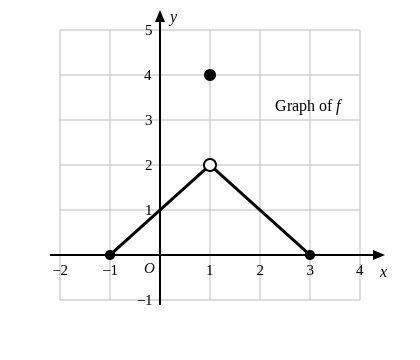
No calculator.Graph of f for −1 ≤ x ≤ 3. A line segment goes from the filled point (−1, 0) up to an open circle at (1, 2), and another segment goes from the open circle at (1, 2) down to the filled point (3, 0). There is a separate filled point at (1, 4).
x
0.9
0.99
0.999
1.001
1.01
1.1
g(x)
−2.7
−2.97
−2.997
−3.003
−3.03
−3.3
The graph of f is shown above, and selected values of a function g are given in the table above. Based on this information, what is the best estimate of x→1lim(f(x)⋅g(x))?
Show answer and explanation
Correct answer: C
From the graph, both segments approach the open circle at (1,2), so limx→1f(x)=2; the filled point (1,4) is f(1) and is not used. From the table, g(x) approaches −3 from both sides. The product rule gives 2⋅(−3)=−6.
A.Both factor limits exist, so the limit of the product exists.
B.−12 uses the value f(1)=4 instead of the limit of f.
C.Correct. limf⋅limg=2(−3)=−6.
D.This drops the negative sign of the limit of g.
Unit 1 of every course is free
This topic has 7 more practice questions in adaptive review, plus lesson videos, unit quizzes, and progress tracking that shows which topics need work.
Unlock all eight AP courses for $10 a month or $40 through June 30, 2027. One-time payment, no auto-renewal.Pricing