AP Business with Personal Finance · Unit 1 · Topic 1.8
1.8 Supply Chains: Practice Questions
A supply chain connects raw materials, production, and distribution. Practice describing each stage, weighing cost, quality, and risk when choosing suppliers, and linking supply chain choices to a competitive advantage strategy.
Free practice set · 10 multiple-choice questions · no sign-up needed
Score0 / 0
Question 1Easy
VoltEdge, a maker of electric-scooter batteries, signs a five-year agreement with the only company that produces a special long-lasting battery cell. Under the agreement, the supplier may not sell the cell to any other scooter-battery maker.
Which competitive advantage strategy does this supply chain decision most directly support?
Show answer and explanation
Correct answer: B
Businesses seeking competitive advantage through barriers to entry build supply chains with exclusive or restrictive agreements, such as agreements that prevent a supplier from selling component parts to rivals.
A.The agreement restricts rivals' access to a component; it does not lower VoltEdge's costs or prices.
B.Correct: Agreements that prevent a supplier from selling component parts to rivals are supply chain decisions that create barriers to entry.
C.Nothing in the scenario describes skilled hand production; the decision is about blocking rivals' access to a part.
D.The agreement concerns who can buy a component, not tailoring products to individual customers.
Question 2Moderate
Two businesses make wooden dining chairs. At Okafor Woodworks, two master carpenters hand-carve each chair to the customer's chosen design and type of wood, producing about 6 chairs per week that sell for $650 each. Steadfast Seating uses automated cutting machines and an assembly line staffed by 40 workers to produce about 5,000 chairs per week in five standard styles that sell for $50 each.
Which of the following customer priorities best explains why Okafor Woodworks chose its production process?
Show answer and explanation
Correct answer: A
Businesses consider customer priorities such as quality, price, and customization, as well as their core competencies, when developing production processes. Okafor's skilled hand-carving to each customer's design fits customers who value customization and will pay $650.
A.Correct: Businesses consider customer priorities such as customization and quality; Okafor makes each chair to the customer's chosen design and wood and charges $650.
B.Okafor charges $650 per chair and makes only about 6 a week, which does not fit customers seeking low prices and large orders.
C.Standard styles describe Steadfast Seating's customers; Okafor makes chairs to each customer's design.
D.Nothing in the scenario suggests customers assemble chairs, and saving money does not match a $650 handmade chair.
Question 3Easy
Two businesses make wooden dining chairs. At Okafor Woodworks, two master carpenters hand-carve each chair to the customer's chosen design and type of wood, producing about 6 chairs per week that sell for $650 each. Steadfast Seating uses automated cutting machines and an assembly line staffed by 40 workers to produce about 5,000 chairs per week in five standard styles that sell for $50 each.
Which of the following correctly describes the production processes the two businesses use?
Show answer and explanation
Correct answer: B
Artisan processes require skilled labor and attention to detail, while mass-production processes typically use technology, assembly lines, and machinery to produce larger quantities. Okafor hand-carves about 6 chairs a week; Steadfast machine-builds about 5,000.
A.This reverses the two: hand-carving by skilled carpenters is artisan; machines and assembly lines are mass production.
B.Correct: Artisan processes rely on skilled labor and attention to detail; mass production uses technology, assembly lines, and machinery to make larger quantities.
C.The type of product does not determine the process; Steadfast uses machines and an assembly line.
D.Selling to customers does not define a production process; Okafor makes six hand-carved chairs a week.
Question 4Hard
Two businesses make wooden dining chairs. At Okafor Woodworks, two master carpenters hand-carve each chair to the customer's chosen design and type of wood, producing about 6 chairs per week that sell for $650 each. Steadfast Seating uses automated cutting machines and an assembly line staffed by 40 workers to produce about 5,000 chairs per week in five standard styles that sell for $50 each.
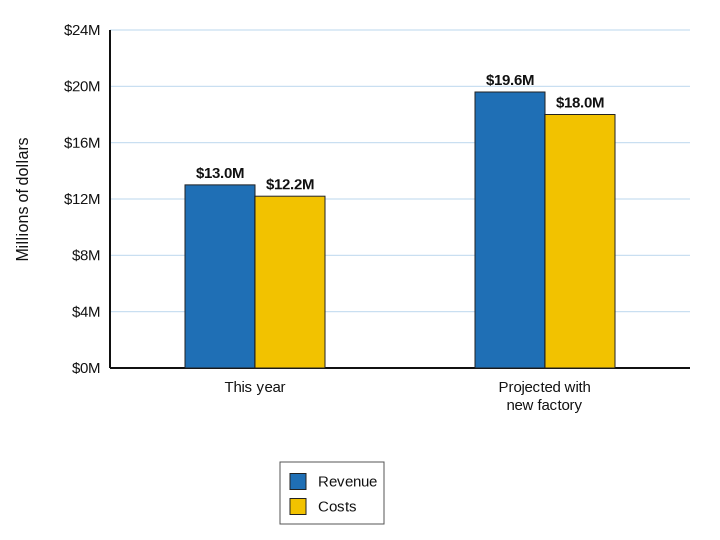
Steadfast Seating competes by offering low prices. It plans to replace its factory with a new, higher-capacity factory. The figure shows Steadfast's annual revenue and costs this year and the projected amounts after the new factory opens.
Steadfast Seating Annual Revenue and Costs (millions of dollars)
Grouped bar chart of Steadfast Seating annual revenue and costs in millions of dollars. This year: revenue $13.0 million and costs $12.2 million. Projected after the new factory opens: revenue $19.6 million and costs $18.0 million.
Which of the following conclusions is supported by the figure?
Show answer and explanation
Correct answer: D
Some businesses competing on low prices scale their operations, building higher-capacity supply chains designed so that revenue increases are greater than cost increases. Revenue rises $6.6 million and costs rise $5.8 million, so profit grows from $13.0M − $12.2M = $0.8M to $19.6M − $18.0M = $1.6M.
A.Costs rise by $5.8 million, which is less than the $6.6 million rise in revenue, so profit increases.
B.This ignores the $5.8 million increase in costs; profit rises by only $0.8 million.
C.Revenue rises by $6.6 million and costs by $5.8 million; the increases are not equal.
D.Correct: Scaling is designed to make revenue increases greater than cost increases: $19.6M − $13.0M = $6.6M; $18.0M − $12.2M = $5.8M; profit goes from $0.8M to $1.6M.
Question 5Moderate
Kettle & Crow Roasters is a small company that roasts specialty coffee and sells it to independent cafés that advertise premium, high-quality coffee. Kettle & Crow buys about 2,500 kilograms (kg) of green coffee beans each month and is comparing two suppliers.
Supplier P: Highland growers' cooperative
Supplier Q: Large export company
Price per kg
$7.80
$6.20
Quality score from taste tests (out of 100)
88
79
On-time deliveries, last two years
96%
82%
Recent issues
None reported
Shipments delayed twice by port strikes
How much more would Kettle & Crow spend each month on green coffee beans if it bought all 2,500 kg from Supplier P instead of Supplier Q?
Show answer and explanation
Correct answer: B
Businesses consider cost when choosing suppliers. The price difference is $7.80 − $6.20 = $1.60 per kg, so buying 2,500 kg from Supplier P costs $1.60 × 2,500 = $4,000 more each month ($19,500 versus $15,500).
A.This is the price difference per kg; it must be multiplied by the 2,500 kg bought each month.
C.This is the total monthly cost from Supplier Q (2,500 × $6.20), not the difference.
D.This is the total monthly cost from Supplier P (2,500 × $7.80), not the difference.
Question 6Moderate
Kettle & Crow Roasters is a small company that roasts specialty coffee and sells it to independent cafés that advertise premium, high-quality coffee. Kettle & Crow buys about 2,500 kilograms (kg) of green coffee beans each month and is comparing two suppliers.
Supplier P: Highland growers' cooperative
Supplier Q: Large export company
Price per kg
$7.80
$6.20
Quality score from taste tests (out of 100)
88
79
On-time deliveries, last two years
96%
82%
Recent issues
None reported
Shipments delayed twice by port strikes
Which of the following best explains why Kettle & Crow would most likely choose Supplier P?
Show answer and explanation
Correct answer: D
Businesses seeking competitive advantage through high-quality goods build supply chains that use high-quality resources. Kettle & Crow sells to cafés that advertise premium coffee, and Supplier P's beans score 88 versus 79 for Supplier Q.
A.Supplier P has the higher price ($7.80 versus $6.20), and Kettle & Crow competes on quality, not low prices.
B.The table says nothing about an exclusive agreement, and being a cooperative does not create one.
C.The scenario gives no information about mass production or roasting costs.
D.Correct: Businesses seeking competitive advantage through high quality build supply chains that use high-quality resources; Supplier P scores 88 versus 79.
Question 7Hard
Kettle & Crow Roasters is a small company that roasts specialty coffee and sells it to independent cafés that advertise premium, high-quality coffee. Kettle & Crow buys about 2,500 kilograms (kg) of green coffee beans each month and is comparing two suppliers.
Supplier P: Highland growers' cooperative
Supplier Q: Large export company
Price per kg
$7.80
$6.20
Quality score from taste tests (out of 100)
88
79
On-time deliveries, last two years
96%
82%
Recent issues
None reported
Shipments delayed twice by port strikes
Which of the following conclusions about the two suppliers is best supported by the table?
Show answer and explanation
Correct answer: C
Businesses weigh cost, quality, efficiency, convenience, and risk when choosing suppliers. Supplier Q is $1.60 per kg cheaper, but its 82% on-time rate and port-strike delays could leave cafés without coffee, threatening Kettle & Crow's competitive advantage and profits.
A.The percentage is correct ($1.60 ÷ $7.80), but price is only one factor; quality and delivery risk also matter, especially to a quality-focused roaster.
B.Supplier P delivered on time 96% of the time, so some shipments were late; no supplier eliminates all risk.
C.Correct: Supplier Q is cheaper but delivered on time only 82% of the time and was delayed by port strikes; such risks may delay product delivery and threaten competitive advantage and profits.
D.Supplier Q's quality score (79) is lower than Supplier P's (88).
Question 8Moderate
PetPal Mobile Vets sends veterinarians in equipped vans to examine pets at customers' homes, and it also offers video check-ups.
Which of the following best describes PetPal's supply chain?
Show answer and explanation
Correct answer: D
In the supply chain for a service, businesses acquire the employees, resources, and delivery systems needed to provide the service to customers in person or virtually. PetPal needs veterinarians, vans and supplies, and booking and video systems.
A.This describes the supply chain for a manufactured good, not for a service delivered by people.
B.This is a goods distribution chain; PetPal provides examinations, not retail medicine sales.
C.An exclusive agreement is a barrier-to-entry tactic, not a description of the steps in PetPal's supply chain.
D.Correct: In the supply chain for a service, businesses acquire employees, resources, and delivery systems to provide the service in person or virtually.
Question 9Easy
Coral Cove Cases makes phone cases from recycled plastic and sells them through retail stores.
Which of the following lists the stages of Coral Cove's supply chain in the correct order?
Show answer and explanation
Correct answer: C
In the supply chain for a good, raw materials are acquired and transported to manufacturing facilities, made into finished goods by workers and equipment, then transported to storage such as a warehouse before going to a distribution center or retail store for customers.
A.Cases cannot be stored as finished goods before they are made; manufacturing comes before storage.
B.Raw materials must be acquired before manufacturing, and storage comes before distribution to stores.
C.Correct: In a supply chain for a good, raw materials go to a manufacturing facility, finished goods go to storage, and then to retail stores for customers.
D.This sequence stores and ships cases before they are manufactured.
Question 10Moderate
Rosa Delgado plans to make fresh salsa with no preservatives and sell it at three farmers' markets within 40 kilometers of her home. The salsa stays fresh for only five days.
Which of the following supply chain plans best fits Rosa's product?
Show answer and explanation
Correct answer: A
Supply chains connect everyone from raw-material sourcing to final delivery and may be local, regional, or global. For a fresh, preservative-free salsa sold at nearby markets, a local chain with weekly sourcing and refrigerated direct delivery matches the five-day shelf life.
A.Correct: A local supply chain with weekly sourcing, nearby production, and refrigerated direct delivery keeps a perishable product fresh and reaches nearby customers quickly.
B.Three months of storage far exceeds the five-day freshness of a preservative-free product.
C.Monthly production and national distribution do not fit a five-day shelf life or customers at three local markets.
D.Sea shipping from overseas takes far longer than five days and does not fit a fresh product sold locally.
Unit 1 of every course is free
This topic has 4 more practice questions in adaptive review, plus lesson videos, unit quizzes, and progress tracking that shows which topics need work.
Unlock all eight AP courses for $10 a month or $40 through June 30, 2027. One-time payment, no auto-renewal.Pricing