AP Business with Personal Finance · Unit 1 · Topic 1.6
1.6 Business Ethics: Practice Questions
Ethical dilemmas pit a core value against another goal. Practice identifying unethical behavior, the codes and training that encourage ethics, and how leaders weigh the effect of a decision on internal and external stakeholders.
Free practice set · 10 multiple-choice questions · no sign-up needed
Score0 / 0
Question 1Easy
Halvorsen Home Appliances sells refrigerators, washers, and stoves in four stores. At the start of the year, Halvorsen began paying its salespeople a commission of 30% of the price of every extended warranty they sell, compared with 2% of the price of each appliance. Halvorsen does not have a written code of conduct for its sales staff. The table shows quarterly data for the year.
Quarter
Extended warranties sold
Customer complaints about misleading warranty claims
Repeat-customer rate
Q1
310
12
34%
Q2
455
29
30%
Q3
590
47
26%
Q4
640
66
21%
Which of the following actions would most likely encourage ethical behavior among Halvorsen's salespeople?
Show answer and explanation
Correct answer: A
Businesses can encourage ethical behavior by implementing codes of conduct, training employees on ethical guidelines, imposing internal repercussions for ethical transgressions, and modeling ethical behavior. Halvorsen currently has no written code.
A.Correct: Codes of conduct, training on ethical guidelines, and internal repercussions are ways businesses encourage ethical behavior.
B.A larger reward for each warranty would strengthen the incentive that is encouraging misleading claims.
C.Hiding complaints conceals information rather than changing behavior; it is itself unethical.
D.Leaving decisions to each individual provides no ethical guidelines, which is the current problem.
Question 2Moderate
Halvorsen Home Appliances sells refrigerators, washers, and stoves in four stores. At the start of the year, Halvorsen began paying its salespeople a commission of 30% of the price of every extended warranty they sell, compared with 2% of the price of each appliance. Halvorsen does not have a written code of conduct for its sales staff. The table shows quarterly data for the year.
Quarter
Extended warranties sold
Customer complaints about misleading warranty claims
Repeat-customer rate
Q1
310
12
34%
Q2
455
29
30%
Q3
590
47
26%
Q4
640
66
21%
Which of the following conclusions is best supported by the data in the table?
Show answer and explanation
Correct answer: C
A business's response to unethical behavior, or its failure to respond, may affect customer relationships and profitability. As warranty sales climbed, complaints about misleading claims rose from 12 to 66 and the repeat-customer rate fell from 34% to 21%.
A.Warranty sales did roughly double (310 to 640), but the table contains no profit data, so no conclusion about net profit is supported.
B.Complaints grew faster (12 to 66, a 450% increase) than warranty sales (310 to 640, about a 106% increase).
C.Correct: Complaints rose from 12 to 66 while the repeat-customer rate fell from 34% to 21%, consistent with unethical practices hurting customer relationships.
D.This reverses the order of the data: the rate fell from 34% in Q1 to 21% in Q4.
Question 3Moderate
Halvorsen Home Appliances sells refrigerators, washers, and stoves in four stores. At the start of the year, Halvorsen began paying its salespeople a commission of 30% of the price of every extended warranty they sell, compared with 2% of the price of each appliance. Halvorsen does not have a written code of conduct for its sales staff. The table shows quarterly data for the year.
Quarter
Extended warranties sold
Customer complaints about misleading warranty claims
Repeat-customer rate
Q1
310
12
34%
Q2
455
29
30%
Q3
590
47
26%
Q4
640
66
21%
Several customers reported that Halvorsen salespeople told them, falsely, that their appliance's manufacturer warranty would be void unless they bought an extended warranty. Which of the following best explains why some salespeople may have made these claims?
Show answer and explanation
Correct answer: A
Unethical behavior such as concealing or falsifying information can occur at all levels, and incentive structures can influence individuals to gain benefits for themselves unethically. Halvorsen's 30% warranty commission, with no code of conduct, rewards warranty sales whether or not customers are told the truth.
A.Correct: Incentive structures can influence individuals' choices to gain benefits for themselves unethically; a 30% commission rewards warranty sales regardless of honesty.
B.This is about customer preferences, and it does not explain why salespeople would make false claims.
C.The scenario gives no information about appliance prices, and high prices would not explain false statements about manufacturer warranties.
D.This reverses the scenario: the commission is 30% on warranties versus 2% on appliances.
Question 4Hard
Orchard Lane Logistics adopted a code of conduct that forbids employees from charging personal expenses to company accounts, and all employees completed training on the code. Six months later, an internal review found that the regional director had regularly charged family dinners to the company's account and that employee violations of the expense rules had increased since the training.
Which of the following best explains the increase in violations?
Show answer and explanation
Correct answer: C
Businesses encourage ethical behavior through codes of conduct, training, internal repercussions, and modeling ethical behavior. Orchard Lane had a code and training, but its regional director broke the rule, so leaders were not modeling the behavior the code requires.
A.The scenario states that all employees completed the training.
B.The code forbids personal charges; it does not encourage them.
C.Correct: Modeling ethical behavior is one way businesses encourage ethics; when a leader breaks the rules, employees receive the opposite signal.
D.Nothing in the scenario mentions pressure from customers or other external stakeholders.
Question 5Moderate
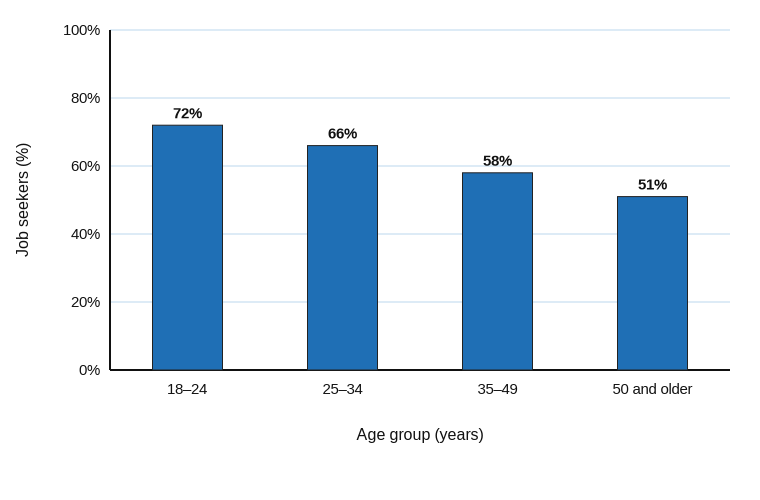
A recruiting firm surveyed 2,000 job seekers about how a company's reputation affects their job search. The figure shows the percentage of job seekers in each age group who said they would not apply to a company with a reputation for unethical behavior.
Job Seekers Who Would Not Apply to a Company With a Reputation for Unethical Behavior, by Age Group
Bar chart showing the percentage of surveyed job seekers in each age group who would not apply to a company with a reputation for unethical behavior: ages 18–24, 72%; ages 25–34, 66%; ages 35–49, 58%; ages 50 and older, 51%.
Which of the following conclusions is best supported by the data?
Show answer and explanation
Correct answer: A
Ethical business practices can attract both customers and employees. In every age group, a majority of job seekers (from 51% to 72%) would not apply to a company with an unethical reputation; the survey does not measure customer behavior.
A.Correct: Every group is above 50% (72%, 66%, 58%, 51%), consistent with ethical practices helping businesses attract employees.
B.This reverses the data: the 50-and-older group has the lowest percentage (51%); the 18–24 group has the highest (72%).
C.51% is more than half.
D.The survey asked job seekers about applying for jobs; it does not measure customer brand loyalty.
Question 6Easy
Which of the following is an example of an employee misusing company property?
Show answer and explanation
Correct answer: A
Unethical behavior includes falsifying or concealing information, misusing company property, and causing harm to employees or customers. Running a personal business with the company's van without permission misuses company property.
A.Correct: Using a company vehicle for personal gain without permission is misusing company property, a form of unethical behavior.
B.Reporting a shortage is transparent, ethical behavior.
C.Using an approved benefit is not a misuse of company property.
D.Negotiating openly for the company's benefit is a normal, ethical business practice.
Question 7Moderate
Ridgeback Outfitters, an outdoor-clothing company, has the vision statement "Protecting the wild places where adventures happen." A supplier offers Ridgeback a fabric that costs 15% less than its current fabric, but the supplier's factory releases dye waste into a nearby river. Ridgeback's CEO turns down the offer, even though accepting it would raise the company's profits.
Which of the following best explains the CEO's response to this dilemma?
Show answer and explanation
Correct answer: B
Business leaders facing an ethical dilemma may choose the course of action most consistent with the business's vision or goals. Ridgeback's vision is to protect wild places, so the CEO rejected a cheaper fabric made by a factory that pollutes a river, even at the cost of higher profits.
A.Accepting the cheaper fabric would have raised profits; the CEO did the opposite.
B.Correct: Business leaders may respond to a dilemma by choosing the course of action most consistent with the business's vision; buying fabric from a polluting factory conflicts with protecting wild places.
C.The CEO made the decision, and a supplier is not employed by Ridgeback, so it is not an internal stakeholder.
D.Here lower costs do conflict with the company's values, which is what makes the situation a dilemma.
Question 8Moderate
Pemberton Snacks makes granola bars labeled "peanut-free." A quality inspector discovers that, because of a cleaning error on a shared production line, about 20,000 bars shipped to stores last week may contain traces of peanuts, which can cause severe allergic reactions. A public recall would cost Pemberton about $150,000 and could hurt short-term sales. No customer has reported a reaction so far. The leadership team estimated the effect of three possible responses on each stakeholder group, using a scale from −5 (great harm) to +5 (great benefit).
Stakeholder group
Response 1: Public recall and warning
Response 2: Quietly remove bars from shelves, no announcement
Response 3: Take no action
Customers
+5
−2
−5
Employees
+1
−1
−2
Owners
−2
−1
+1
Community
+3
−2
−4
Which of the following best explains why Pemberton faces an ethical dilemma?
Show answer and explanation
Correct answer: B
Ethical dilemmas exist when a core value such as transparency, fairness, or empathy conflicts with other values or with business goals. Telling customers about the possible peanut traces is transparent but costly (about $150,000 and lost short-term sales).
A.This is an operational issue; it does not describe a conflict between a value and a business goal.
B.Correct: An ethical dilemma exists when a core value such as transparency conflicts with business goals; warning customers would cost about $150,000 and may hurt sales.
C.The absence of reports does not remove the risk; being open about the risk still conflicts with protecting sales.
D.Leaders consider the impact of their responses on both internal and external stakeholders, including customers.
Question 9Easy
Pemberton Snacks makes granola bars labeled "peanut-free." A quality inspector discovers that, because of a cleaning error on a shared production line, about 20,000 bars shipped to stores last week may contain traces of peanuts, which can cause severe allergic reactions. A public recall would cost Pemberton about $150,000 and could hurt short-term sales. No customer has reported a reaction so far. The leadership team estimated the effect of three possible responses on each stakeholder group, using a scale from −5 (great harm) to +5 (great benefit).
Stakeholder group
Response 1: Public recall and warning
Response 2: Quietly remove bars from shelves, no announcement
Response 3: Take no action
Customers
+5
−2
−5
Employees
+1
−1
−2
Owners
−2
−1
+1
Community
+3
−2
−4
Which of the following is an external stakeholder in Pemberton's decision?
Show answer and explanation
Correct answer: C
Internal stakeholders (owners, managers, employees) are directly involved in a business's operations; external stakeholders, such as customers, government agencies, and community members, are not employed by the business but have a vested interest in its decisions. Parents who buy the bars are customers.
A.The inspector is an employee, which makes the inspector an internal stakeholder.
B.Owners are internal stakeholders; they are directly involved in the business's operations and outcomes.
C.Correct: Customers are not employed by or directly involved in the business but have a vested interest in its decisions, so they are external stakeholders.
D.Managers are internal stakeholders.
Question 10Hard
Pemberton Snacks makes granola bars labeled "peanut-free." A quality inspector discovers that, because of a cleaning error on a shared production line, about 20,000 bars shipped to stores last week may contain traces of peanuts, which can cause severe allergic reactions. A public recall would cost Pemberton about $150,000 and could hurt short-term sales. No customer has reported a reaction so far. The leadership team estimated the effect of three possible responses on each stakeholder group, using a scale from −5 (great harm) to +5 (great benefit).
Stakeholder group
Response 1: Public recall and warning
Response 2: Quietly remove bars from shelves, no announcement
Response 3: Take no action
Customers
+5
−2
−5
Employees
+1
−1
−2
Owners
−2
−1
+1
Community
+3
−2
−4
If Pemberton's leaders choose the response that results in the greatest total benefit across all stakeholder groups, which response will they choose?
Show answer and explanation
Correct answer: D
Leaders often weigh the benefits and costs of each response for every stakeholder group and choose the one with the greatest total benefit or least total harm. Totals: Response 1 = +7, Response 2 = −6, Response 3 = −10, so they would choose Response 1.
A.Focusing on one group ignores the total: Response 3 sums to −5 − 2 + 1 − 4 = −10, the lowest of the three.
B.Response 2 sums to −2 − 1 − 1 − 2 = −6; the approach compares totals across all groups, not the score for owners alone.
C.Response 1 is the right choice, but this reason is false: it harms owners (−2).
D.Correct: Response 1 sums to 5 + 1 − 2 + 3 = +7, compared with −6 for Response 2 and −10 for Response 3.
Unit 1 of every course is free
This topic has 4 more practice questions in adaptive review, plus lesson videos, unit quizzes, and progress tracking that shows which topics need work.
Unlock all eight AP courses for $10 a month or $40 through June 30, 2027. One-time payment, no auto-renewal.Pricing